AR/VR & Immersive Technology

AR/VR & Immersive Technology

Redblox Technologies creates and develops augmented reality, virtual reality, and mixed reality technologies that enable
businesses to visualize products, train teams, and engage customers in ways that flat displays cannot. We integrate
immersive technology into your business, connecting it to the systems and outcomes that matter to you.

Introduction

Augmented reality, virtual reality, and mixed reality have moved out of
research labs and into everyday business operations. Retailers use AR to
let shoppers preview products before buying. Manufacturers use VR to
train employees on equipment they can’t yet risk touching. Real estate
teams use immersive walkthroughs to sell properties before they’re built.
Across every industry, immersive technology is becoming a practical tool
for solving problems that traditional interfaces struggle with, spatial
understanding, hands-on practice, and emotional engagement.

At the same time, an immersive experience that appears amazing but does
not relate to a measurable business goal is a demonstration, not a solution.
Redblox Technologies develops AR/VR and immersive technology solutions
that begin with a business goal, such as improved training results, more
conversion, fewer errors, and faster onboarding, then work backward to the
optimal combination of hardware, platform, and interface design. As a
result, technology earns its position in the business, rather than just on the
trade show floor.

What Is AR/VR & Immersive Technology?

AR/VR and immersive technology refers to a set of tools, augmented reality, virtual reality, mixed reality, and extended
reality, that let people see, interact with, and learn from digital content layered onto or replacing their physical
environment.

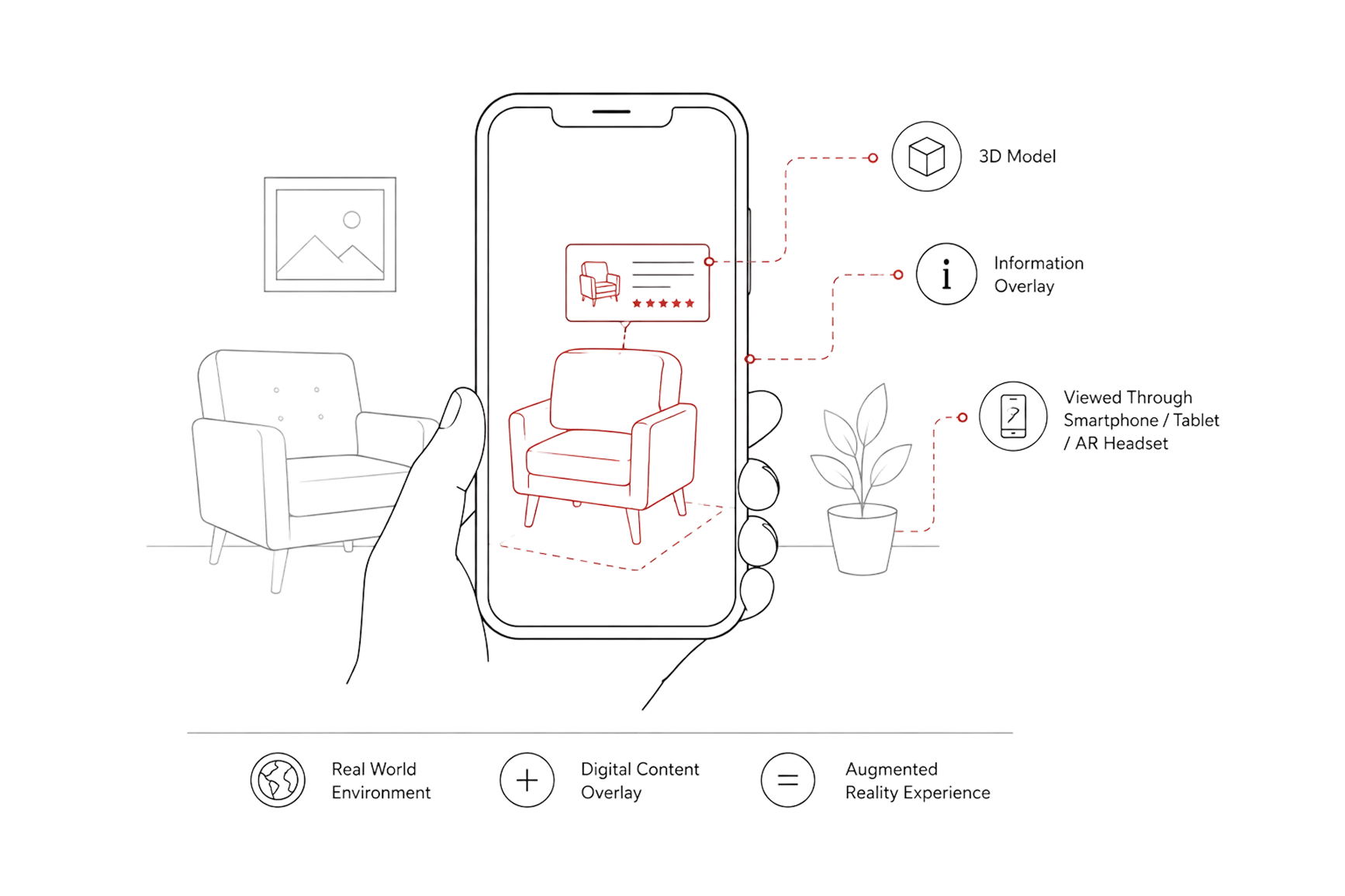
A hand holding a phone that places a 3D chair into a real room, labelled with the 3D model, information overlay, and the devices the experience is viewed through
Augmented Reality (AR)
Overlays digital content, images, information, or 3D models, onto the real world,
typically viewed through a smartphone, tablet, or AR headset. Users stay grounded in
their physical environment while digital elements are added on top of it.
Virtual Reality (VR)
Mixed Reality (MR)
Extended Reality (XR)
Immersive 3D experiences

Our AR/VR & Immersive Technology Services

Augmented Reality Development

We develop AR applications that overlay
digital information, product models, and
interactive instructions over the physical
environment using mobile devices, tablet
& AR headsets, allowing businesses to
add meaning & interactivity to real-world
environments and items.
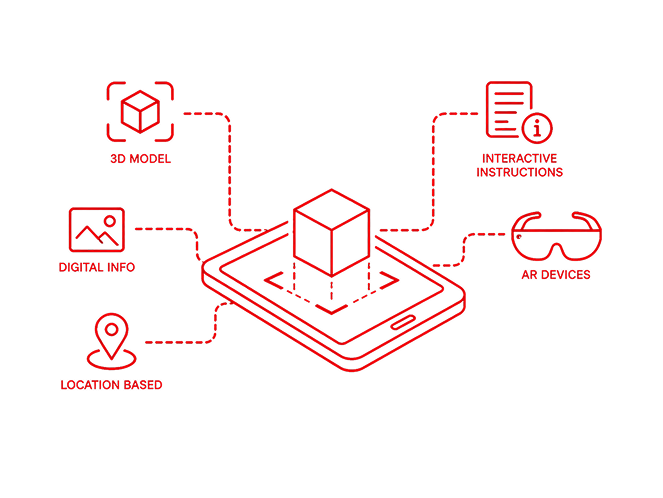
A tablet projecting a 3D cube, linked to 3D model, digital info, location-based, interactive instructions, and AR device labels

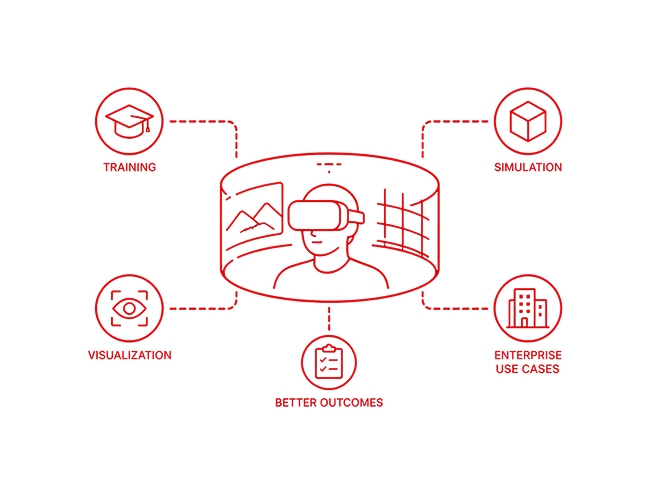
Virtual Reality Development

We develop VR applications for training,
simulation, visualization, and enterprise
use cases where a fully immersive,
controlled environment delivers better
outcomes than a physical setup, from
equipment training to space planning.

A person in a VR headset inside a virtual environment, linked to training, visualization, better outcomes, simulation, and enterprise use case labels

Industries We Serve

Healthcare

Immersive simulations let clinical staff practice
procedures and patient interactions in a risk-
free environment before working with real
patients.

Healthcare illustration

Education

Immersive 3D content turns abstract concepts,
anatomy, physics, historical events, into
environments students can explore and interact
with directly.

Education illustration

Manufacturing

VR-based training lets workers practice on
complex or hazardous equipment without
production downtime or safety risk.

Manufacturing illustration

Real Estate

Virtual property tours, off-plan walkthroughs, and fit-out visualization that let buyers judge a space before it exists.

Real Estate illustration

Retail

Virtual try-on, in-store AR navigation, and 3D product configuration that shorten the distance between interest and purchase.

Retail illustration

Logistics

Warehouse picking overlays, load planning, and hands-free instruction delivered on headsets that keep both hands on the task.

Logistics illustration

Hospitality

Virtual venue previews, immersive destination content, and staff onboarding that rehearses service scenarios before a guest arrives.

Hospitality illustration

Business Applications

Immersive technology supports a wide range of practical business functions, including:

  • Product visualization and configuration
  • Virtual training and skills practice
  • Employee onboarding
  • Safety and compliance simulations
  • Digital twins of physical assets or facilities
  • Virtual tours of properties, campuses, and
    facilities
  • Interactive product demonstrations
  • Virtual showrooms and digital storefronts
  • Remote collaboration in shared 3D
    environments
  • Customer engagement, immersive
    marketing campaigns
  • Event and exhibition experiences
  • 3D simulations for planning and decision-
    making
  • Educational and instructional experiences
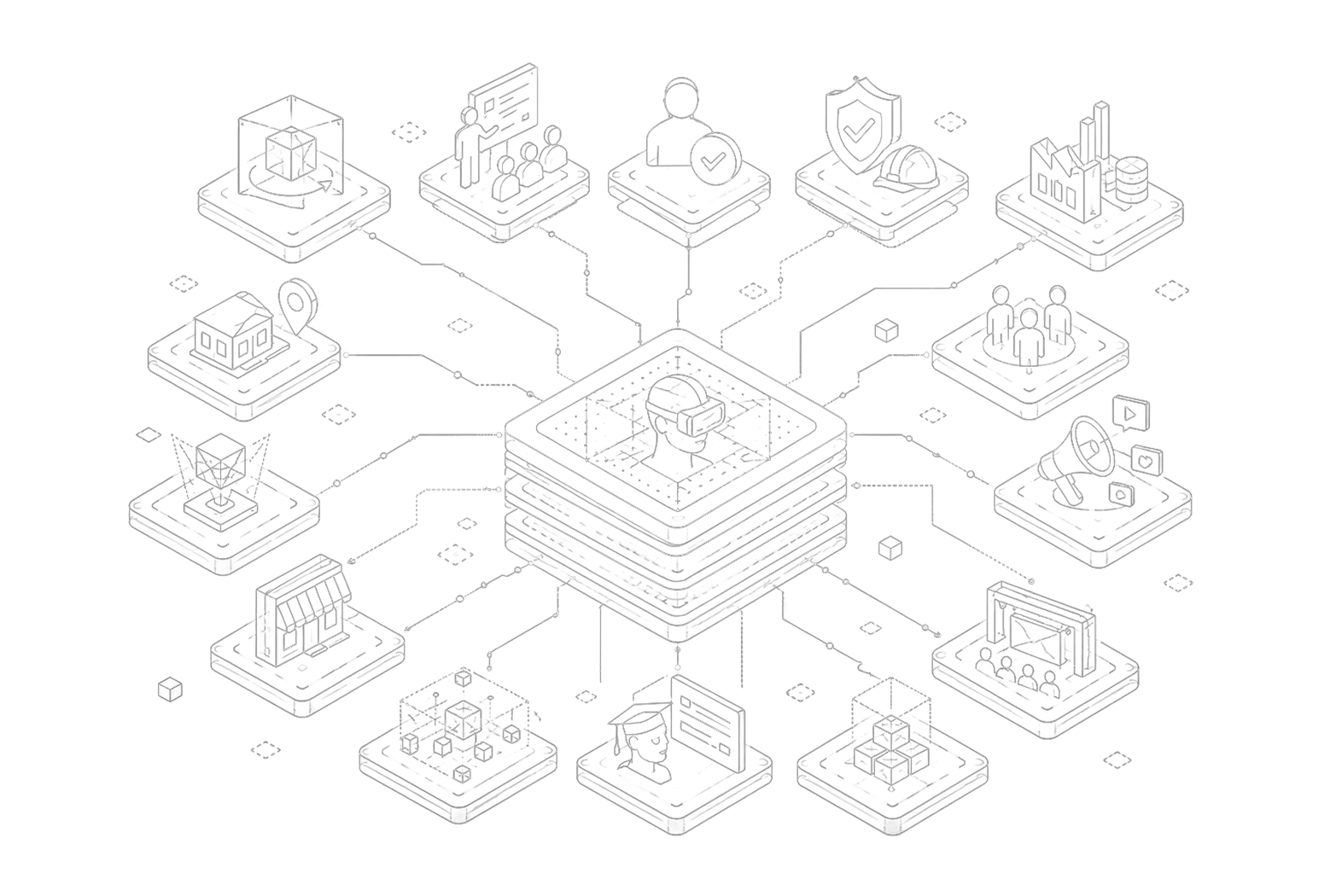
An isometric platform diagram linking product, training, onboarding, safety, retail, marketing, events, and simulation nodes to a central immersive core

Why Businesses Invest in AR/VR

Better customer engagement

Interactive, spatial experiences hold attention longer than static images or
video, giving customers a reason to spend more time engaging with a
product or brand.

Improved product understanding

Letting customers view a product from every angle, in context, or in a
configured state reduces the uncertainty that leads to returns,
cancellations, or hesitation.

More immersive training

Practicing a procedure in a simulated environment builds familiarity and
confidence in a way that reading a manual or watching a video cannot.

Reduced training risk

VR simulation lets employees make mistakes and learn from them in
situations involving hazardous equipment, emergency response, or
expensive machinery, without real-world consequences.

Faster learning through simulation

Repeatable, scenario-based practice compresses the time it takes to build
proficiency, since employees can run through a scenario multiple times
without added cost or setup.

Improved visualization

Complex spatial information, building layouts, equipment assemblies, data
relationships, is often easier to understand in 3D than in a diagram or
spreadsheet.

New digital experiences

Immersive technology opens interaction formats, configurators, virtual
environments, spatial storytelling, that aren’t possible on a standard web
page or app screen.

Stronger brand differentiation

A well-designed immersive experience gives a business a distinctive way to
be remembered, particularly in categories where competitors rely on
conventional formats.

Better remote collaboration

Shared 3D environments let distributed teams review designs, walk through
spaces, and make decisions together without needing to be in the same
physical location.

Increased interaction and retention

Because immersive experiences require active participation rather than
passive viewing, users tend to retain more of what they see and do.

Our AR/VR Development Approach

Step1

Discovery & Business Analysis

Understand business objectives, users, workflows,
target devices, and the immersive use cases worth
building.

Discovery & Business Analysis illustration
Step

Architecture & Technology Strategy

Define the XR platform, target devices, engine,
integrations, and content pipeline strategy.

Architecture & Technology Strategy illustration
Step

3D Asset & Environment Production

Model, texture, and optimize the assets and environments so they hold quality within the target device's budget.

3D Asset & Environment Production illustration
Step

Development & Integration

Build the application and connect it to the data, content, and enterprise systems it depends on.

Development & Integration illustration
Step

Device Testing & Optimization

Test on the real hardware for frame rate, tracking stability, comfort, and session length before release.

Device Testing & Optimization illustration
Step

Deployment & Rollout

Ship to stores, enterprise device fleets, or the web, with provisioning and content updates in place.

Deployment & Rollout illustration
Step

Support & Continuous Improvement

Monitor usage and performance, refresh content, and extend the experience as devices and requirements change.

Support & Continuous Improvement illustration

Technology Capabilities

Redblox Technologies works across the technical building blocks that immersive experiences depend on, including:

  • AR application development for mobile and headset devices
  • VR application development for standalone and tethered headsets
  • 3D environment design and development
  • Real-time interactive experiences
  • AI-powered immersive experiences with adaptive or intelligent behavior
  • API and enterprise system integration to connect immersive experiences with existing business data
  • Simulation environments for training and scenario practice
  • 3D visualization and product configuration tools
  • Interactive digital twins of physical assets and facilities
  • Mobile AR built for smartphones and tablets
  • Web-based immersive experiences that run without a dedicated app
  • Cloud-connected immersive applications for multi-user and remote access

AR/VR + AI

Combining artificial intelligence with immersive technology moves experiences from fixed, scripted
interactions toward ones that respond and adapt to the user in real time. Practical applications include:

AI-Powered Virtual Environments
That Adjust Content, Difficulty, Or
Pacing Based On User Behavior

Automated Content Personalization
That Adapts What’s Shown Based On
Context Or User Intent

Personalized Immersive Experiences
That Tailor Content To A User’s Role,
History, Or Preferences

AI-Assisted Training Simulations
That Evaluate Performance And
Provide Targeted Feedback

Conversational Virtual Experiences
Where Users Interact Through Natural
Language Rather Than Fixed
Menus

Intelligent Digital Assistants
Embedded Directly Inside Immersive
Environments To Guide Users
Through Tasks

Intelligent Virtual Characters
Capable Of Responding Naturally
Within A Training Or Customer-Facing
Scenario

AI-Powered 3D Interaction
Where Objects And Environments
Respond Intelligently To User
Actions

Used deliberately, AI does not just make immersive experiences look more advanced, it makes them more useful, by letting the experience
respond to the person using it rather than following a single fixed path.

Why Redblox Technologies?

Business-focused technology
solutions

Every immersive project starts from a
business objective, not a technology
feature list.

Cross-domain technical expertise

Our teams work across AR/VR, AI/ML,
blockchain, mobile, web, and custom
software, which means immersive solutions
are built by people who also understand the
systems they need to connect to.

Custom-built immersive
experiences

Solutions are designed around your specific
use case, users, and environment rather
than adapted from a generic template.

Business-focused technology
solutions

Every immersive project starts from a
business objective, not a technology
feature list.

Redblox Technologies works with businesses as a technology partner, not a one-off development vendor, helping teams think through where
immersive technology fits, and building the solution that follows from that thinking.

Custom Software Development
Integration

AR/VR and immersive apps are rarely used in isolation. A training simulation must report
completion statistics to an LMS. A product configurator must retrieve live inventory and price
from a backend system. To capture leads, a virtual showroom must be connected to a CRM
system. Getting this properly involves more than immersive design skills; it also necessitates
good software engineering underpinning the experience.

Redblox Technologies’ custom software development services support this by building the
APIs, integrations, and backend systems that let immersive applications connect with the
tools your business already relies on, so the experience isn’t a standalone demo, but a
working part of your operations.

AR / VR App
APIs & Backend Integration
Business SystemsLMS • CRM • ERP
Connected Business Solution

Frequently Asked Questions

Ready to Build the Next Immersive Experience?

Whether you’re exploring AR product visualization, VR training simulation, or a fully custom XR solution, Redblox Technologies can help
you turn immersive technology into a practical part of your business.

Fill your details below and get in touch with our domain experts

Name*
Email*
Phone*
Company*
Requirements*