Enterprise AI Optimization
AI Model Fine-Tuning Services
Turn General-Purpose AI Models Into Task-Specific Intelligence
Redblox assists enterprises in adapting current foundation models to their domain, workflows, language, and answer
formats, resulting in AI that performs measurably better on the tasks on which your business depends.
Better task performance. More consistent outputs. Lower inference costs where appropriate. Production-ready AI.
AI Models Are Powerful, But Generic
Models Aren't Built for Your Business
General-purpose foundation models are trained to be broadly capable, not correct for your business. Put to work on real operations, the gaps show up quickly: unfamiliar industry terminology, proprietary workflows the model was never exposed to, inconsistent structured responses, and business rules too specific for a prompt to fully capture.
Common friction points we see:


Proprietary Internal Workflows And Business Logic

Structured Response Requirements (JSON, Forms, Templates)

Domain-Specific Classification And Routing

Consistent Tone And Behavior Across Thousands Of Interactions

Specialized Document Formats

Multilingual And Regional Requirements

Rising Inference Costs At Scale

Latency Requirements For Real-Time Use Cases

Strict Internal Evaluation Criteria
What Are AI Model Fine-Tuning Services?
Fine-tuning improves an existing foundation model by employing carefully curated, domain-specific examples to make it more suitable for a certain job, behavior, format, or industry. Instead of starting from scratch, Redblox builds on proven open-weight or corporate base models and tailors their behavior to your needs.
Fine-tuning is one option among several, and it’s rarely
the only one you need:
- Prompt engineering shapes behavior and instructions without touching the model, fast, but limited in how specialized it can get.
- RAG (retrieval-augmented generation) grounds responses in current, private, or frequently changing data.
- Fine-tuning teaches a model consistent task behavior and domain patterns directly.
- Model distillation transfers capability from a larger model into a smaller, faster one built for a narrower job.
- Smaller specialized models can outperform larger general models on a well-defined task, at a fraction of the cost.
Fine-Tuning vs RAG vs Prompt Engineering
| Approach | Best For | Main Advantage | Limitation |
|---|---|---|---|
| Prompt Engineering | Behavior and instructions | Fast to implement | Limited specialization |
| RAG | Dynamic / private knowledge | Grounds responses in current data | Retrieval quality matters |
| Fine-Tuning | Task behavior and domain patterns | Consistent specialized behavior | Requires quality training / evaluation data |
| Smaller / Distilled Models | High-volume workloads | Lower latency and cost | May have narrower capabilities |
| Hybrid Approach | Complex enterprise AI | Combines multiple techniques | More engineering complexity |
Rather than focusing just on fine-tuning, Redblox begins each engagement with an architecture review. In many cases, the
correct response is RAG, better prompting, model routing, or a combination of approaches, and we will tell you so.
Our AI Model Fine-Tuning Services

Fine-Tuning Strategy & Model Selection
We assess your business objectives, target tasks, existing models, data availability, accuracy and latency requirements, cost restrictions, security requirements, and deployment environment before recommending the model and optimization strategy that best meets your needs, rather than a default approach.
Supervised Fine-Tuning
Curated examples demonstrate model task-specific behavior, domain language, response structure, categorization patterns, instruction execution, and customized workflows. More data does not always mean better data; we value high-quality, representative datasets over raw volume.
LoRA, QLoRA & Parameter-Efficient Fine-Tuning
Modern parameter-efficient techniques (LoRA, QLoRA, and related PEFT methods) reduce training resource requirements, experimentation cost, adaptation time, and storage footprint. We apply them where they fit the model, task, and infrastructure, not as a default for every project.
Domain-Specific Model Adaptation
We customize model behavior, not just vocabulary, for industries such as financial services, healthcare, manufacturing, retail, hospitality, logistics, legal, real estate, SaaS, and customer support, aligning models with terminology and processes appropriate to your teams’ actual operations.
Structured Output & Workflow-Specific Fine-Tuning
We train models to return valid JSON, filled forms, templates, and tool-call arguments in the exact structure your systems expect, so outputs flow straight into downstream applications, automations, and agent workflows without brittle parsing or manual correction.
Preference Optimization & Alignment
Using preference-based techniques such as DPO and reviewer feedback, we align model responses with your quality standards, brand voice, safety policies, and compliance requirements, so the model consistently favors the answers your teams would approve.
AI Models We Can Fine-Tune or Optimize
Open-Weight Language Models
Llama-family, Mistral-family, Gemma-family, and other suitable open-weight models, the right choice depends on your use case and deployment requirements, not a fixed list.
Enterprise Foundation Models
Fine-tuning and customization options depend on each provider’s current capabilities, API policies, and deployment model. We assess what’s available and appropriate for your case; we don’t promise fine-tuning support for every proprietary model.
Vision & Multimodal Models
Image understanding, document intelligence, visual classification, multimodal workflows, and vision-language applications.
Our AI Model Fine-Tuning Process
Step1
Business & Use-Case Assessment
Identify the exact task and success criteria.

Step
RAG vs Fine-Tuning Architecture Decision
Determine whether the problem needs prompting, RAG, fine-tuning, smaller models, model routing, or a hybrid architecture.

Step
Data Preparation & Curation
Collect, clean, label, and de-identify representative training and evaluation data.

Step
Model Training & Optimization
Fine-tune with the method that fits the model, task, and infrastructure, from full fine-tuning to LoRA or QLoRA.

Step
Evaluation & Benchmarking
Measure accuracy, format adherence, safety, latency, and cost against the base model and your current solution.

Step
Deployment & Integration
Deploy to the right serving environment and connect the model to your applications, APIs, and agents.

Step
Monitoring & Continuous Improvement
Track quality and drift in production, and retrain on fresh data as your business changes.

Business Benefits
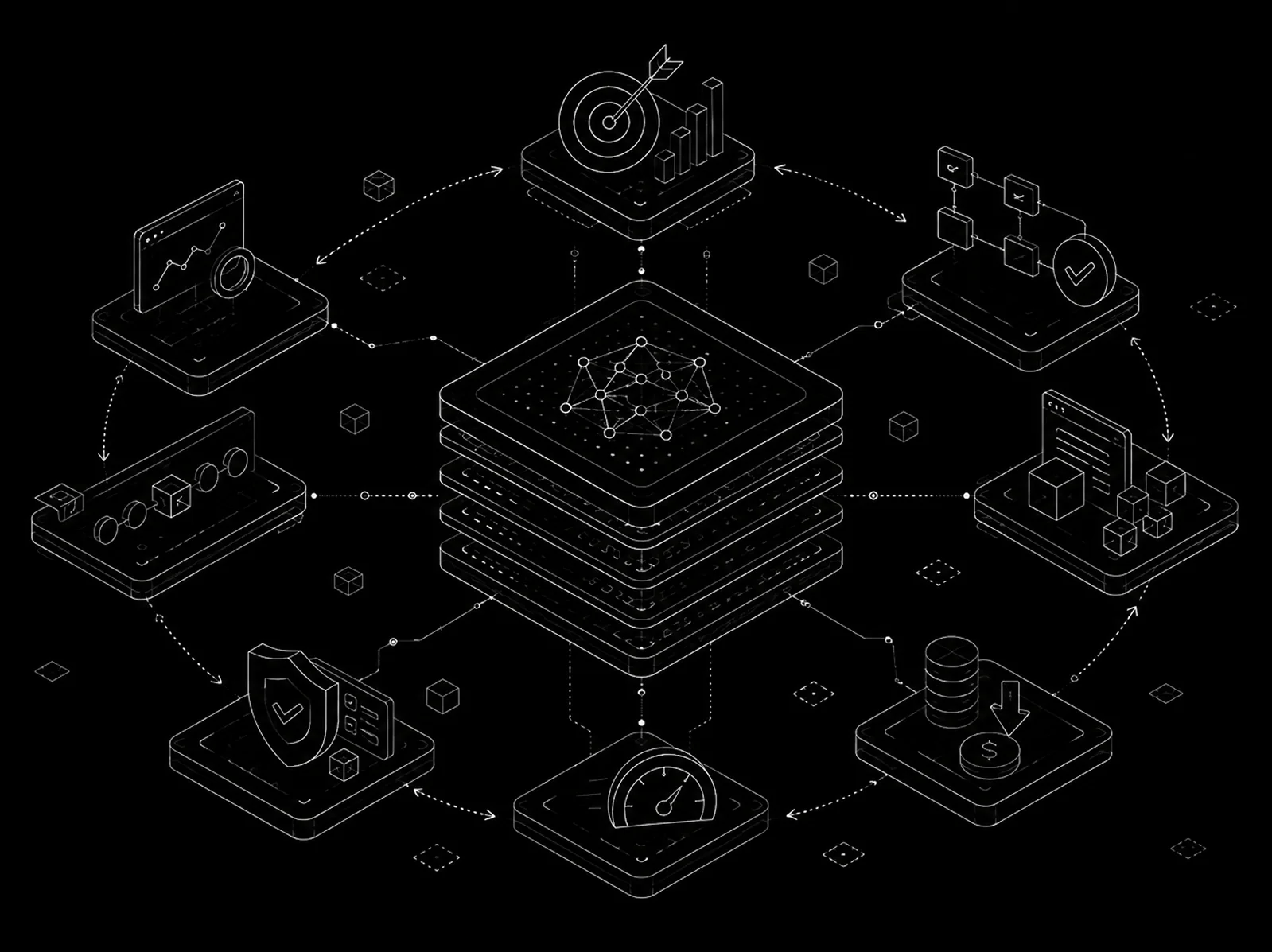
Higher Task Accuracy
Improve performance on specialized business tasks.
More Consistent Outputs
Reduce variability in structured workflows and repetitive AI tasks.
Better Domain Understanding
Adapt model behavior to specialized terminology and workflows.
Lower Inference Costs
Use optimization, smaller models, routing, and compression where appropriate.
Faster Response Times
Deliver lower latency with compact fine-tuned models for real-time applications.
Greater Control & Ownership
Own your model weights and deployment, tuned to your policies.
Fine-Tuning for Agentic AI
AI agents rely on models that behave predictably under pressure by following structured instructions, selecting the appropriate tool, producing outputs that a downstream system can parse, adhering to workflow constraints, correctly handling domain terminology, and escalating when confidence is insufficient to act.
As agentic systems enter production, model optimization becomes a critical component of ensuring their reliability, rather than an afterthought.
FINE-TUNINGDomain + Instructions
RELIABLE AI MODELPredictable Outputs
TOOL USETools • Workflows
VALIDATIONConfidence + Rules
SAFE EXECUTIONAct or Escalate
Enterprise AI Security & Data Privacy
Fine-tuning touches sensitive business data at every stage, from dataset creation to deployed model
artifacts. We build governance into the lifecycle:
Data access controlsDataset governanceSensitive data handlingSecure training environmentsAuditabilityPrivate deployment optionsModel artifact protectionEvaluation controlsAccess management
Why Choose Redblox Technologies?

Business-First AI Architecture
We determine whether fine-tuning is actually the right solution before implementation.
Full AI Engineering Capability
From data engineering and model optimization to deployment and AI applications.
Production-Focused Approach
Models are built to run inside your real workflows and systems, not just to pass a lab demo.
Measurable Evaluation
Every model ships with benchmarks tied to the accuracy, cost, and latency you care about.
Secure By Design
Data governance, access controls, and private deployment built into every engagement.
Cost-Aware Optimization
Smaller models, routing, and compression where they lower inference spend.
Long-Term Partnership
Monitoring, retraining, and iteration as your data and business change.
Technology & Engineering Stack
Model & Training
- PyTorch
- Hugging Face
- Transformers
- PEFT, TRL


Experiment Tracking & MLOps
- MLflow
- CI/CD pipelines
- Weights & Biases
- Model registries

Data & Evaluation
- Python
- Pandas
- Dataset tooling
- Custom evaluation pipelines
- Benchmarking frameworks


Deployment
- Docker
- Kubernetes
- GPU infrastructure
- Cloud AI infrastructure
- API-based inference


Who Needs AI Model Fine-Tuning?
Good indicators fine-tuning is a fit:
- Generic models repeatedly fail a specialized task
- Prompting has reached its limits
- Output consistency is critical
- A large set of high-quality task examples exists
- Specialized behavior must be embedded into the model itself
- Inference cost needs optimization at scale
- A smaller specialized model could outperform a larger general model on a narrow task
- The organization needs tighter control over model behavior
When fine-tuning may not be the right fit:
- Knowledge changes frequently
- The problem is primarily information retrieval
- There isn’t enough quality training data yet
- Prompting already solves the problem
- RAG is a better architectural fit
- A model provider’s hosted customization options are sufficient
Frequently Asked Questions
Build an AI Model That Performs for Your Business
Your AI model should not merely produce impressive results. It should execute consistently against the tasks that are important to your organization.
Fill your details below and get in touch with our domain experts