Multi - Agent AI Services

Multi-Agent AI Systems
Development Services

Enterprise operations are too complex for a single AI to handle alone. Redblox Technologies builds multi-agent AI
systems. collaborative networks of intelligent AI agents that divide, reason, and conquer your most demanding
business workflows together.

80%

Reduction in manual processing time

6+

Industries transformed

3x

Operational throughput increase

24/7

Autonomous agent availability

What Are Multi-Agent AI Systems?

A Multi-Agent AI System is a network of specialized AI agents, each with a
different purpose, capacity, and area of responsibility, that interact,
collaborate, and coordinate to accomplish goals no single agent could do on
its own.

Think of it as a high-performing team: a manager who makes sure
everything remains in line, analysts who collect and analyze data,
specialists who carry out particular tasks, and a strategist who sets
direction. These functions are performed by intelligent AI agents
functioning independently inside a regulated architecture in a multi-agent
AI system.

Each agent uses a structured protocol to communicate with other agents,
keeps its own memory, and has access to particular tools and data sources.
Through a common knowledge layer, the system communicates context,
allowing each agent to comprehend the bigger picture while concentrating
on its particular task.

The ability to automate multi-step, cross-functional workflows that
previously required human coordination at every intersection, from
customer service escalation chains to multi-department financial approvals
to real-time supply chain decisions, creates something truly powerful for
businesses.

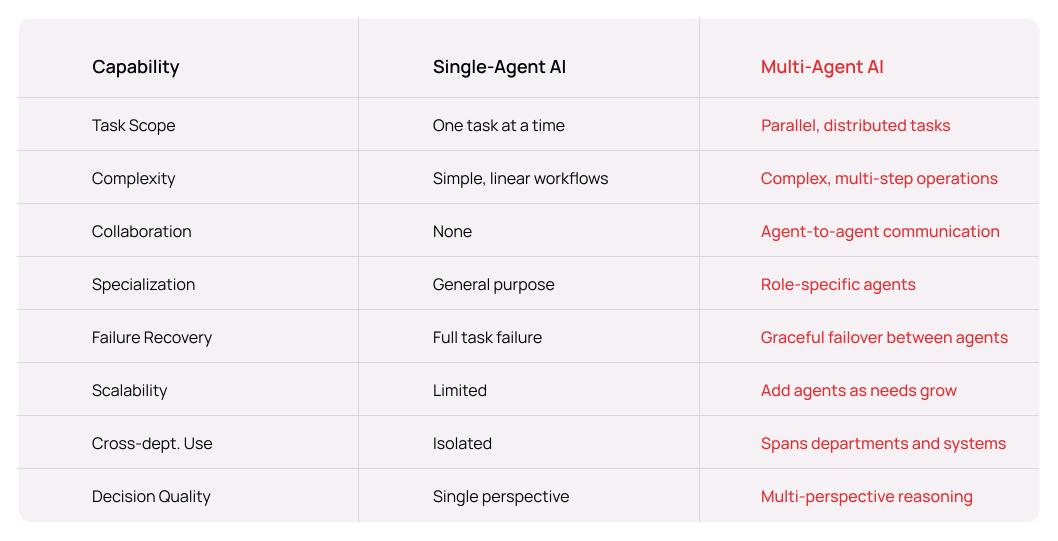
Single-Agent AI vs Multi-Agent AI

Comparison table of Single-Agent AI vs Multi-Agent AI across task scope, complexity, collaboration, specialization, failure recovery, scalability, cross-department use and decision quality

How Multi-Agent AI Systems Work

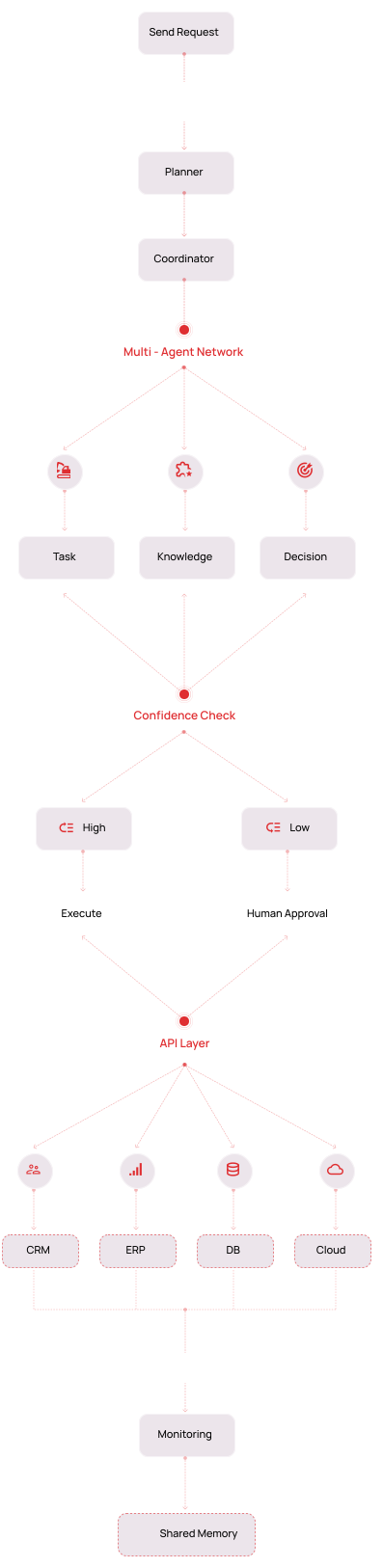
Every system we build has a clear internal structure, agents with defined roles, a communication layer, a shared knowledge base, and governance controls that keep everything accountable. Here is how the key agent types work together inside a production multi-agent AI system.

Multi-agent AI system flow: a request is planned and coordinated into a multi-agent network of task, knowledge and decision agents, routed through a confidence check to execution or human approval, an API layer connecting CRM, ERP, DB and cloud, a monitoring layer and a shared memory layer.

Planner Agent

Receives the high-level business goal, breaks it into sub-tasks, assigns them to the appropriate specialist agents, and manages the execution sequence. The Planner is the strategic layer, it understands the objective and orchestrates everything beneath it.

Coordinator Agent

Manages inter-agent communication, resolves task conflicts, monitors overall progress across the agent network, and escalates blockers to the human approval layer when necessary. The Coordinator is the operational manager of the system.

Task Agents

Specialized executors, each focused on one domain. A data extraction agent, a drafting agent, a calculation agent, a compliance checking agent, all working in parallel on their assigned sub-tasks. Specialization is what drives output quality.

Knowledge Agent

Maintains and queries the shared knowledge base, vector databases, internal documents, and real-time data feeds, giving all agents access to relevant, up-to-date context without redundant data retrieval.

Decision Agent

Evaluates options, weighs trade-offs against predefined business rules, and selects the optimal path forward. Low-confidence decisions are flagged for human review rather than proceeding on a guess.

API Integration Agent

Connects the agent network to external systems - CRMs, ERPs, databases, payment gateways, communication platforms, translating data formats, managing authentication, and handling rate limits.

Monitoring Agent

Tracks system-wide performance in real time, detects anomalies, logs every agent decision for audit purposes, and generates alerts when SLAs are at risk of breach.

Human Approval Layer

When agent confidence falls below a defined threshold or a decision carries high business risk, the system pauses and routes to a human reviewer, with full context, reasoning, and recommended options provided.

Shared Memory Layer

A persistent context store that all agents read from and write to, ensuring consistent understanding across the agent network even as tasks hand off between specialists over multi-hour or multi-day workflows.

Why Businesses Need Multi-Agent AI
Systems

Individual tasks are handled by single-agent AI tools. People, departments, and systems are all part
of your company's interrelated operations. Multi-Agent AI Systems are most useful when there is a
coordination gap

Market Statistics

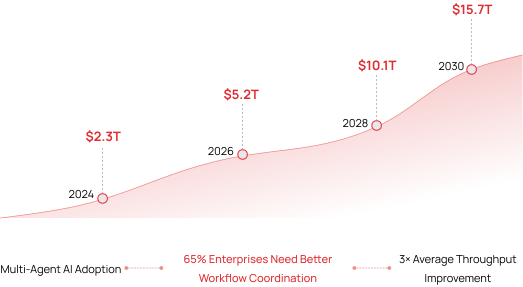
  • The global AI market is projected to contribute $15.7 trillion to the global economy by 2030, with autonomous coordination systems driving the largest share of productivity gains. (PwC)
  • 65% of enterprise executives say workflow coordination bottlenecks are their top barrier to scaling operations without proportional headcount increases. (McKinsey)
  • Organizations deploying multi-agent AI systems report on average 3x throughput increases versus isolated single-agent tools for complex process automation.
Multi-agent AI market growth curve rising from $2.3T in 2024 to $15.7T by 2030, with 65% of enterprises needing better workflow coordination and a 3x average throughput improvement

Key Business Drivers

Complex Workflows Require Coordination:

A customer complaint touching support, billing, logistics, and management can't be handled by one AI. A multi-agent AI system routes it correctly, keeps all parties in sync, and resolves it end-to-end, automatically.

Parallel Execution Beats Sequential Processing:

While one agent handles documentation, another runs calculations, another checks compliance, all simultaneously. Tasks that took days take hours.

Specialization Delivers Better Outcomes:

Specialist agents trained on domain-specific data make decisions with the precision of an experienced team member in that field, consistently and at scale.

Scale Without the Hiring Equation:

Demand spikes don't require emergency hiring when your enterprise AI agents can absorb them. Add capacity to the network, scale back when pressure passes.

24/7 Cross-Timezone Operations:

A multi-agent AI system operates continuously, ensuring critical workflows don't pause because a time zone changed or a shift ended.

Built-in Fault Tolerance:

When one agent encounters an edge case it can't handle, the coordinator reroutes the task. The system degrades gracefully rather than failing completely.

Our Multi-Agent AI Development
Services

Each engagement is tailored to your unique company environment. Our AI create the agent
architecture your workflows truly need, rather than fitting your activities into a template.

Enterprise Multi-Agent Architecture

The foundation of everything we build. We design the complete blueprint for your multi-agent AI
system, defining agent roles, communication protocols, data flow, memory architecture, and
governance controls before a single line of code is written.

Enterprise Goal
AI Orchestration
Planning AgentAnalysis AgentDecision Agent
Communication Layer
Shared Memory
CRMERPDBSlackEmail

Business Use Cases

Multi-agent AI systems aren't theoretical. Here's what they look like when they're running inside real business operations.

Customer Support

An intake agent classifies and routes queries, specialist agents handle billing, technical, and logistics issues in parallel, and a resolution agent confirms closure and updates the CRM, all without a human touching the ticket.

Sales Automation

A prospecting agent sources leads, a qualification agent scores them, a nurture agent manages outreach sequences, and a handoff agent triggers a human seller at the optimal moment, with full context ready.

Hotel Operations

A booking agent manages reservations, a guest communication agent handles pre-arrival and in-stay requests, a revenue management agent adjusts pricing dynamically, and a review agent monitors and responds to post-stay feedback.

Real Estate

A listing agent maintains property data, a lead agent qualifies buyer inquiries, a scheduling agent manages viewings, and a negotiation support agent prepares offer analysis, across dozens of properties simultaneously.

Industries We Serve

Every agent system we develop incorporates deep sector knowledge. Before we create the first line of architecture, we are aware of your operational limitations, regulatory environment, and consumer expectations.

Hospitality

Guest services, revenue management, booking coordination, and reputation management, all running autonomously across your properties.

Hospitality illustration

Real Estate

Lead management, property operations, buyer nurture sequences, and transaction coordination, scaled across large portfolios without proportional staff growth.

Real Estate illustration

Healthcare

Patient operations, appointment workflows, insurance processing, and care coordination, with HIPAA-aligned human-in-the-loop controls at clinical decision points.

Healthcare illustration

Manufacturing

Quality assurance, supply chain coordination, predictive maintenance, and production reporting, agents embedded in your operational layer.

Manufacturing illustration

Retail

Inventory intelligence, demand forecasting, customer engagement, and omnichannel support, coordinated by agents that understand your catalog and your customers.

Retail illustration

Logistics

Routing optimization, carrier management, shipment tracking, and exception handling, reducing manual coordination while improving delivery performance.

Logistics illustration

Financial Services

Transaction processing, compliance monitoring, fraud detection, and client reporting - built with audit trail requirements and governance controls regulators expect.

Financial Services illustration

Education

Student support automation, administrative workflow management, learning pathway coordination, and institutional knowledge management.

Education illustration

Technology Stack

We're technology pragmatists. The right tool for the job, not the one we happen to be most familiar with. Here's what we use and why.

Foundation Models

We select the foundation model that best matches each agent's task profile, reasoning-heavy tasks may favor Claude, real-time interaction may favor GPT-4o, and specialized domains may benefit from fine-tuned Llama deployments. No model lock-in.

OpenAI GPT-4o
Anthropic Claude
Google Gemini
Meta Llama

Development Process

Ten stages, no shortcuts. Every step has a clear output. You always know where you are, what
comes next, and what it will deliver.

Step1

Business Discovery

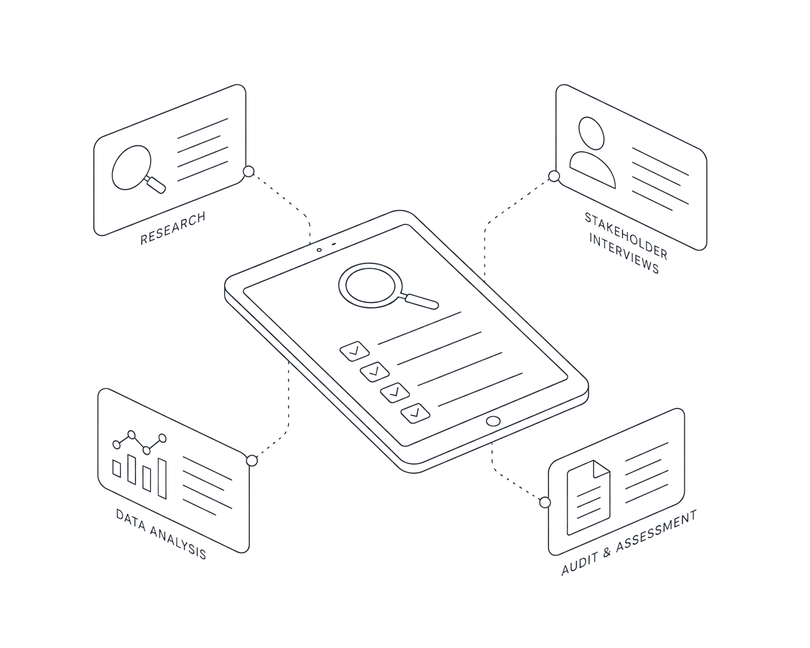
We map current workflows, identify automation candidates, quantify the business value at stake, and agree on what success looks like before any design work begins. This is a genuine diagnostic, not a sales presentation.

Business Discovery illustration
Step

AI Strategy

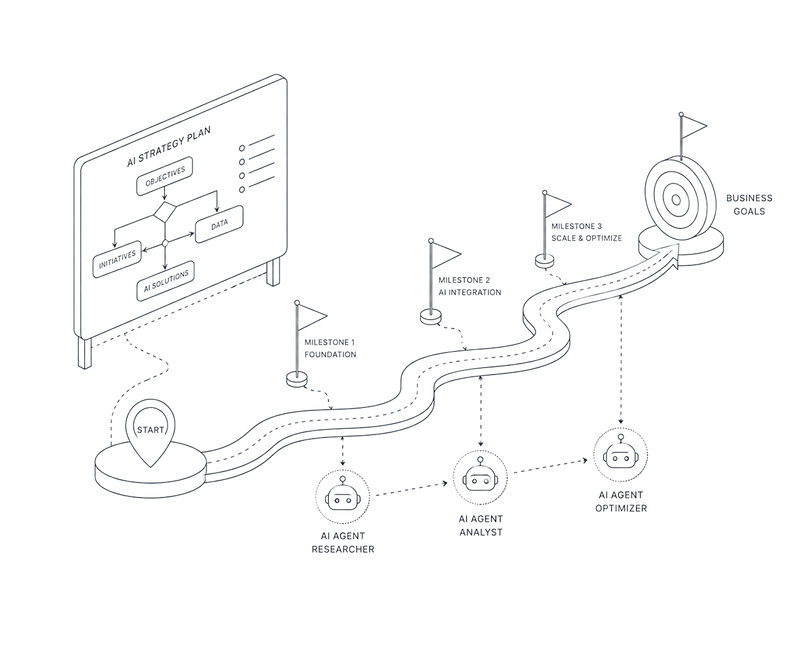
We develop a tailored AI strategy aligned with your business goals, priorities, and operational challenges. This includes defining the right AI use cases, implementation roadmap, technology stack, success metrics, and adoption plan to ensure every investment delivers measurable business outcomes.

AI Strategy illustration
Step

Agent Design

Each agent is designed individually: its role, responsibilities, tools, memory access, communication interfaces, and decision boundaries. This is where generalist thinking stops and domain specificity begins.

Agent Design illustration
Step

Multi-Agent Architecture

The complete system blueprint, agent topology, orchestration layer, knowledge architecture, inter-agent protocols, and governance framework. This document governs every subsequent build decision.

Multi-Agent Architecture illustration
Step

Integration

Connecting agents to your existing infrastructure - ERP, CRM, databases, communication platforms. We handle authentication, data transformation, and API management so your team doesn't have to.

Integration illustration
Step

Testing

Agents are tested individually and as a network - unit tests, integration tests, edge case simulations, stress tests, and accuracy benchmarks. Nothing enters production until it performs to specification.

Testing illustration
Step

Security Review

Every deployment undergoes a dedicated security review covering access controls, data handling, prompt injection defenses, audit logging, and compliance alignment with your industry's regulatory requirements.

Security Review illustration
Step

Deployment

Phased rollout - starting with a pilot scope that minimizes risk while delivering early value. Your team receives full training, documentation, and a defined hypercare period before full production expansion.

Deployment illustration
Step

Continuous Learning

Agents improve over time through feedback loops, performance data, and periodic retraining. The system gets smarter as it handles more of your actual workload, compounding your investment's value.

Continuous Learning illustration
Step

Support & Optimization

Ongoing partnership, monitoring agent performance, expanding the system as your needs evolve, and ensuring your AI workforce scales with your business rather than requiring a rebuild when requirements change.

Support & Optimization illustration

Why Choose Redblox Technologies?

AI development companies are many. Few have specialized in agentic AI solutions, developed AI-native engineering from the ground
up, and brought unique platform architecture to enterprise engagements.

AI-Native Engineering

We didn't retrain from another technology discipline. AI is the core of how we build, not a layer added to traditional software engineering. That changes the quality and scalability of what we deliver.

The OtonomiQ Platform

Proprietary infrastructure built specifically for enterprise AI agent deployment. You get production-grade orchestration, governance, and monitoring without building it from scratch.

Enterprise AI Expertise

We understand complex stakeholder environments, compliance requirements, legacy system constraints, and the organizational dynamics of large-scale AI transformation services.

Custom AI Solutions

No templates, no off-the-shelf agents renamed for your industry. Every system is engineered from the architecture stage for your specific workflows, data environment, and business objectives.

Enterprise Security

Security is designed in at the architecture stage, not bolted on at the end. Every deployment meets enterprise-grade standards for access control, data handling, audit logging, and compliance alignment.

Scalable Architecture

Every system we build is designed to scale - handling 10×, 100× the workload without requiring a complete rebuild. We architect for your future state, not just your current one.

Long-Term Partnership

We structure every engagement for ongoing collaboration, iterating, expanding, and optimizing your intelligent business systems as your needs grow.

Frequently Asked Questions

Straightforward answers to the questions technology and operations leaders ask most often when
evaluating Multi-Agent AI Systems.

Ready to Build an Intelligent AI
Workforce?

You've seen enough AI presentations. What you need is a partner who can actually build it, and prove the
value before asking for your full commitment. Redblox Technologies offers a structured discovery
session designed specifically for technology and operations leaders evaluating Multi-Agent AI
Development.

What happens in your discovery session:

  • 60-90 minute working session - a genuine diagnostic of your operations, not a sales deck
  • Workflow mapping - we identify the 3-5 processes where multi-agent AI systems will deliver the highest and fastest return
  • ROI estimate - realistic cost/benefit numbers so you can make an informed internal business case
  • Implementation roadmap - a sequenced, realistic plan tailored to your technology environment, risk tolerance, and business priorities
  • No pressure, no generic demos - just an honest, expert conversation about what agentic AI solutions can do for your specific business.

Fill your details below and get in touch with our domain experts