IoT in Healthcare Industry
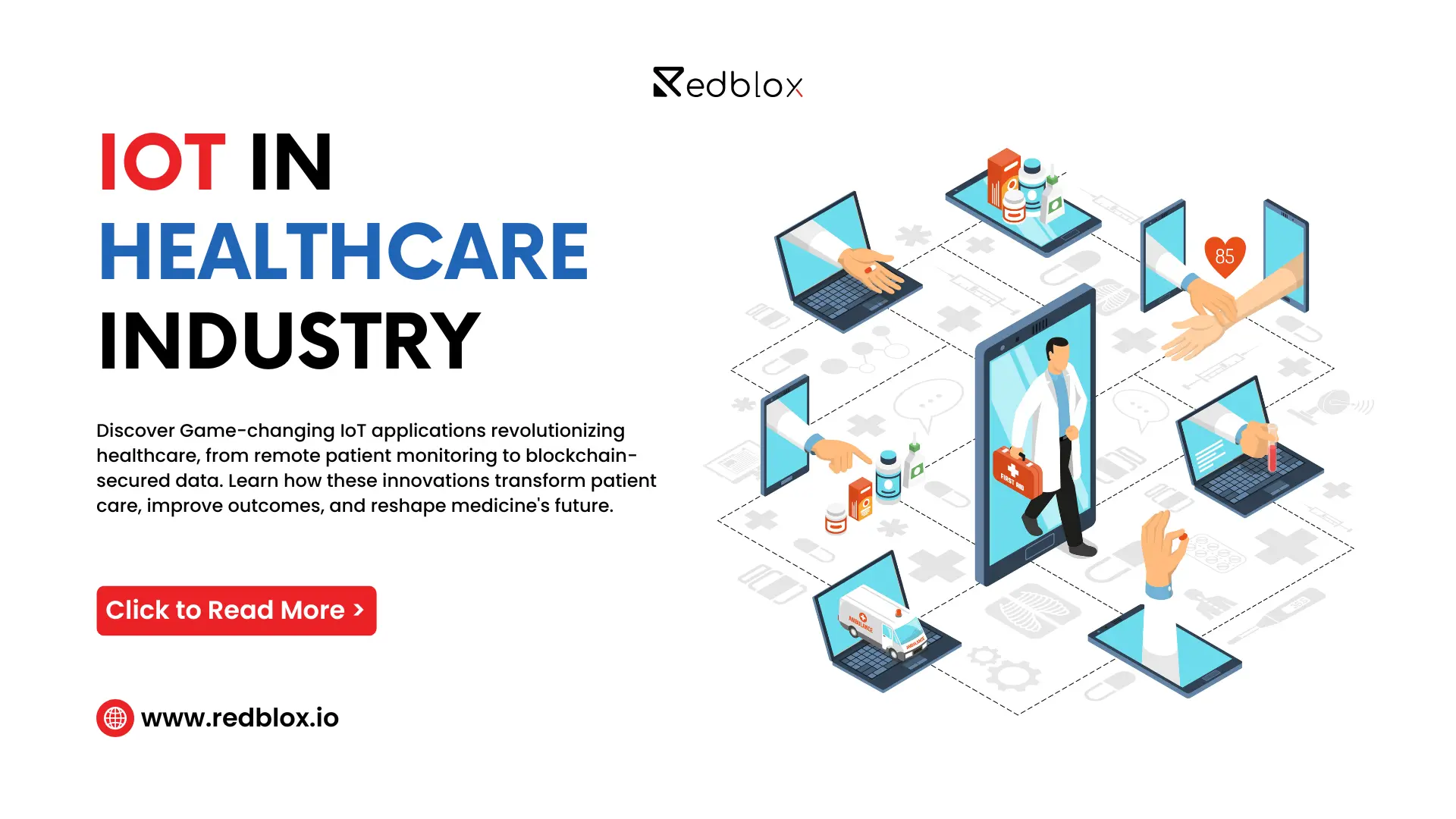
In today’s fast-changing healthcare world, the Internet of Things (IoT) is becoming a powerful tool, set to transform patient care, improve efficiency, and boost health outcomes. From smart wearables to AI-based diagnostic tools, IoT is changing how healthcare providers deliver care and how patients manage their health information. But are healthcare providers ready to fully embrace this technology?
As we explore IoT in healthcare, we’ll look at ten cutting-edge applications that could reshape the industry. We’ll discuss the challenges, benefits, and future of this technology, giving you practical insights to stay ahead in this evolving field.
Remote Patient Monitoring: The Future of Preventive Care
Remote patient monitoring (RPM) is leading the way in IoT healthcare advancements. With the help of connected devices and sensors, healthcare providers can now monitor patients' vital signs and health data in real-time, even when they are not in the hospital or clinic.
Key benefits of RPM include:
- Detecting health problems early
- Fewer hospital readmissions
- Better patient involvement and self-care
- More affordable care
Real-world Application: Managing Chronic Diseases
For patients with conditions like diabetes, heart disease, or COPD, remote monitoring devices can track things like blood sugar, heart rate, and breathing. This information is sent to healthcare providers, helping them make timely adjustments to treatment and provide personalized care.
Smart Wearables: Giving Patients Real-Time Health Information
Smart wearables have evolved from simple fitness trackers into powerful health monitoring tools. These devices can track important health data like heart rate, sleep, stress levels, and physical activity.
Key features of smart wearables in healthcare include:
- Continuous health tracking
- Personalized health advice
- Syncing with electronic health records (EHRs)
- Fall detection and emergency alerts for seniors
The global market for smart healthcare wearables is expected to reach $30.1 billion by 2026, with a growth rate of 26.9% from 2021 to 2026 (source: Allied Market Research).
Real-world Example: Monitoring Heart Health Advanced smartwatches now come with ECG functions, helping users detect irregular heart rhythms, like atrial fibrillation. Early detection can lead to timely medical care, potentially preventing serious heart problems.
Smart Pills and Ingestible Sensors: Revolutionizing Medication Adherence
Smart pills and ingestible sensors are revolutionizing medication adherence.
Poor drug adherence is a major concern in healthcare, resulting in compared treatment outcomes and higher healthcare expenses. IoT-enabled smart pills and ingestible sensors are addressing this issue front on.
Benefits of Smart Pill Technology:
- Real-time medication tracking
- Improved patient compliance and drug efficacy monitoring.
- Improved adherence leads to lower healthcare expenses.
Recent Stats Says: The global smart pill market is anticipated to reach $3.83 billion by 2025, increasing at a 14.2% CAGR between 2019 and 2025 (source: Grand View Research).
Real-world applications include mental health treatment.
Smart pills can offer accurate drug intake data to healthcare providers for patients with diseases such as schizophrenia or bipolar disorder, where adherence is critical. This information allows for timely interventions and individualized treatment adjustments.
IoT-Powered Hospital Asset Monitoring: Increasing Resource Efficiency
Healthcare facilities must manage their assets effectively to provide high-quality care while controlling expenses. IoT-powered asset tracking solutions are revolutionizing hospital equipment and resource management.
Principal benefits of asset tracking for IoT:
- Medical equipment's position in real-time
- Enhanced control over inventories
- Decreased theft and loss of equipment
- Increased effectiveness of operations
The healthcare asset management market is expected to develop at a compound annual growth rate (CAGR) of 28.9% from 2020 to 2027, reaching $84.5 billion.
IoT-enabled asset monitoring makes it possible for personnel in crowded emergency rooms to find vital equipment like portable X-ray machines and defibrillators quickly, speeding up response times and possibly saving lives.
AI-Powered Diagnostic Instruments: Increasing Precision and Rapidity
Artificial intelligence and Internet of Things (IoT) integration is transforming medical diagnostics by providing faster and more accurate findings across a range of specializations.
Advantages of diagnostics enabled by AI:
- increased illness detection accuracy
- Quicker diagnosis and start of therapy
- Decreased inaccuracies made by humans
- Backing for individualized treatment programs
Global AI in healthcare market is projected to develop at a compound annual growth rate (CAGR) of 44.9% from 2020 to 2026, reaching $45.2 billion.
Artificial intelligence (AI) algorithms are able to accurately identify anomalies in medical images such as CT, MRI, and X-rays. With the use of this technology, radiologists can more accurately and swiftly detect possible problems.
Smart Hospitals: Developing Networked Healthcare Environments
The idea of "smart hospitals" combines a number of IoT technologies to establish a smooth, effective, and patient-focused medical setting.
Important characteristics of smart hospitals include:
- Patient flow management technology is automated
- Building management systems powered by IoT
- Staff and patient tracking in real-time
- Smart inventory control
IoT sensors are used by smart hospitals to track personnel availability, equipment status, and OR utilization. By using this data, surgical efficiency is increased overall, turnaround times are shortened, and scheduling is optimized.
Increasing Access to Healthcare through Telemedicine and Virtual Care
IoT is enabling the fast growth of virtual care and telemedicine, removing barriers to access and enhancing healthcare across geographic boundaries.
IoT-enabled telemedicine benefits include:
- Improved availability of healthcare in outlying places
- Shorter wait times and distances for patients
- Care delivery that is economical
- Increased happiness and involvement of patients
By 2025, the global telemedicine industry is anticipated to have grown to $191.7 billion, with a compound annual growth rate (CAGR) of 37.7%.
Even for patients in remote or poor regions, IoT devices may provide real-time patient data to professionals, providing precise remote diagnosis and treatment suggestions.
Medical Equipment Predictive Maintenance: Reducing Downtime
Medical equipment maintenance is being revolutionized by IoT sensors and predictive analytics, which guarantee that vital instruments are always functional when needed.
Predictive maintenance advantages include:
- Decreased unavailability of equipment
- Reduced upkeep expenses
- longer equipment life
- Enhanced security for patients
IoT sensors can keep an eye on MRI machine parts and anticipate possible malfunctions before they happen. By taking this preventive measure, unplanned downtime is reduced and patient scan availability is guaranteed.
IoT-Powered Clinical Trials: accelerating the Process of Drug Development
IoT technology is revolutionizing clinical trials by providing new methods for more accurate and efficient patient data collection and analysis.
Benefits of IoT in clinical research:
- Real-time gathering of patient data
- Increased adherence and retention of participants
- Improved integrity and quality of the data
- Quicker drug approval and trial completion procedures
IoT devices facilitate decentralized clinical trials by enabling remote patient monitoring and data collection, which lessens the need for frequent site visits and increases participant variety.
Blockchain for Healthcare Data Security: Guarantees Privacy and Interoperability
As IoT devices create massive volumes of sensitive health data, blockchain technology is emerging as an essential option for data security and interoperability.
Key advantages of blockchain for healthcare IoT:
- Improved data security and privacy
- Improved interoperability between systems
- Transparent and auditable data transactions.
- Patient-controlled health data sharing.
Blockchain technology can be used to construct a secure, decentralized network for sharing patient data among healthcare providers, maintaining data integrity and patient privacy while allowing for seamless care coordination.
Conclusion:
As we've seen, the Internet of Things has the potential to impact many aspects of healthcare delivery, from patient care and clinical trials to hospital operations and data security. The potential benefits are massive: better patient outcomes, more operational efficiency, and more personalized, data-driven treatment.
However, the effective adoption of IoT in healthcare needs careful consideration of issues such as data security, interoperability, and regulatory compliance. In order to maximize the benefits of IoT, healthcare providers must invest in strong infrastructure, staff training, and cybersecurity safeguards.
One thing is sure as we look to the future: the IoT transformation in healthcare is only getting started. In the digital age, those that adopt these tools and adjust to the evolving environment will have the best chance of providing high-standard, patient-centered care.
Is your healthcare company prepared to take the lead in this IoT-driven change? It is time to take action. Contact Redblox Technologies - IoT Solutions and Service Providers in Pondicherry, India. Talk to our experts today!
Fill your details below and get in touch with our domain experts
Start a conversation

+91 7550051204

contact@redblox.io

Book 1:1 Meeting with Redblox

@redblox_technologies

Follow Us on


Copyright © 2026 - RedBlox Technologies Pvt. Ltd