It has no access to live business data, so its answers are generic or outdated.
AI Integration
AI Integration Services for Enterprise Applications, Workflows & Business Systems
Redblox designs and implements the connective infrastructure that integrates OpenAI, Claude, Gemini, and custom AI models into the CRMs, ERPs, and legacy systems that already manage your business, safely and at enterprise scale, without removing what works.
What Are AI Integration Services?
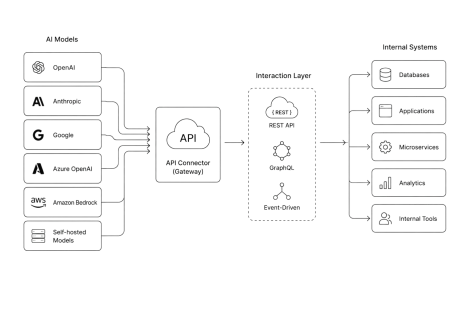
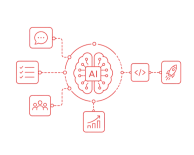
AI integration services are the engineering discipline of connecting artificial intelligence models (large language models, vision systems, speech engines, and AI agents) to existing business software such as CRM, ERP, data warehouse, internal tools, and customer-facing applications.
This is a different category from AI development. AI development involves creating or fine-tuning a model. AI integration is about making that model accessible: connecting it to APIs, authentication layers, data pipelines, business logic, and user interfaces so it can function in real-world operational workflows rather than languishing in a sandbox.
How AI Integration Works
Why Businesses Struggle After Building AI
A working model is not a working system. Enterprises frequently invest in a capable LLM or a well-trained AI feature, only to find it delivers no measurable business value because:
It isn't connected to the tools employees actually use, so adoption stays low.
There's no governance layer, so IT and security teams block it from production.
It was built as a standalone demo, with no path to scale across departments or regions.
Integration is what transforms a promising AI capability into a commercial outcome: a support ticket addressed automatically within Zendesk, a sales forecast prepared within Salesforce, and an invoice reconciled within SAP without human intervention.
Why Integrating AI with Existing Systems Matters
Enterprise software already stores years of business logic, compliance regulations, and institutional data. Rebuilding it around a new AI layer is slower, riskier, and more expensive than integrating AI into it. Integration safeguards existing investments in core systems while expanding their capabilities, which is why integration, rather than model selection, is now the key obstacle for enterprise AI adoption.
Why Your Business Needs AI Integration
Most organizations don't have an AI capability problem. They have a connection problem. Left unaddressed, it shows up as:
AI Models and Platforms We Integrate

OpenAI GPT models
Including GPT-4 class models for reasoning, generation, and function calling.

Claude (Anthropic)
For enterprise reasoning, long-context document analysis, and agentic workflows.

Google Gemini
For multimodal reasoning across text, image, and video.

Meta Llama
For private, self-hosted open-weight deployments.

Mistral
For efficient, cost-controlled inference at scale.

Azure OpenAI Service
For enterprises standardized on Microsoft's cloud and compliance stack.

Amazon Bedrock
For AWS-native, multi-model deployments.

Google Vertex AI
For enterprises building on Google Cloud.
Microsoft Copilot
Extending and customizing Copilot inside Microsoft 365 and Dynamics.
Custom and fine-tuned LLMs
Proprietary models trained on your domain data.
Vision AI
Image recognition, defect detection, document and ID verification.
Speech AI
Voice transcription, voice agents, and interactive voice response.
Multimodal AI
Vision-language and audio-capable models that accept mixed inputs in a single request.
AI agents
Agent frameworks such as CrewAI and AutoGen, the runtimes we build and deploy agents on.
Platforms We Integrate With
| Category | Platforms |
|---|---|
| CRM |  Salesforce  HubSpot  Zoho  MS Dynamics 365 |
| ERP |  SAP  Oracle NetSuite  Oracle ERP CloudMS Dynamics 365 |
| E-commerce |  Shopify  Adobe Commerce  WooCommerce |
| Healthcare | Epic  Cerner |
| Hospitality | PMSPOSBooking & Reservation |
| Finance | QuickBooksXeroPayment gateways |
| Communication |  Slack  MS Teams  WhatsApp Business API  Email |
| Cloud |  AWSMicrosoft Azure  Google Cloud Platform |
Our AI Integration Services

Custom AI Integration
Purpose-built integration between your chosen AI models and your specific combination of business systems, rather than a one-size-fits-all connector.

LLM Integration
Connecting large language models (OpenAI, Claude, Gemini, or open-weight models) into applications and products for reasoning, generation, summarization, and classification.

API Integration
Designing and building the API layer, authentication, and data contracts that let AI models securely exchange information with your systems.

Enterprise AI Integration
Architecture and delivery for large-scale, multi-department AI rollouts across global enterprise environments, with governance and scalability built in.

Legacy System Modernization
Bridging AI capabilities into older systems that predate modern APIs, using middleware, RPA, and custom connectors.

Workflow Automation
Embedding AI into multi-step business processes such as approvals, onboarding, claims processing, and order fulfillment.

CRM AI Integration
Lead scoring, next-best-action recommendations, summarization, and conversational assistants inside Salesforce, HubSpot, Zoho, or Dynamics.

ERP AI Integration
AI-driven forecasting, anomaly detection, and process automation inside SAP, Oracle, or Dynamics ERP environments.

RAG Integration
Retrieval-augmented generation pipelines so AI answers are grounded in your organization's documents and records.

Vector Database Integration
Implementing and connecting Pinecone, Weaviate, or Milvus so unstructured data becomes searchable by AI in real time.

AI Agent Integration
Autonomous agents that execute multi-step tasks across multiple connected systems under defined guardrails.

Chatbot Integration
Conversational AI embedded into websites, support desks, WhatsApp, and internal tools, connected to live business data.

Knowledge Base Integration
Connecting AI to internal wikis, SharePoint, Confluence, and document repositories for sourced, accurate answers.

Business Process Automation
Redesigning cross-departmental processes end to end, combining AI reasoning, RPA, and system integrations to remove the hand-offs between teams.

Document Intelligence Integration
AI extraction, classification, and routing of information from invoices, contracts, claims, and forms.

Voice AI Integration
Speech recognition and voice agents connected into contact centers, IVR systems, and field service apps.

Computer Vision Integration
Image and video AI integrated into manufacturing quality control, retail inventory, and security workflows.

Multimodal AI Integration
Models that combine text, image, audio, and video reasoning into a single business workflow.
Our AI Integration Process
Step1
Discovery
Understand your business goals, current systems, data landscape, and where AI can create measurable impact.

Step
Business Analysis
Map existing workflows, identify integration points, and quantify expected ROI before writing a line of code.

Step
Architecture Design
Design the integration architecture: API layer, data flow, orchestration logic, security model, and scalability plan.

Step
Data Mapping
Define how data moves between AI models and business systems, including transformation, validation, and retrieval logic.

Step
API Development
Build the connective APIs and middleware needed to bridge AI models with your existing platforms.

Step
AI Integration
Connect models, deploy RAG pipelines, configure agents, and embed AI into user-facing workflows.
Step
Testing
Validate functional accuracy, performance under load, and edge-case behavior before production.
Step
Security Validation
Audit authentication, data handling, access controls, and compliance posture.

Step
Deployment
Roll out to production using a phased or full-scale approach based on risk tolerance.

Step
Monitoring
Track performance, model behavior, cost, and system health with real-time observability.
Step
Optimization
Continuously refine prompts, retrieval quality, model selection, and workflow logic.
Technology Stack
| Category | Technologies |
|---|---|
| Languages & Frameworks |  Python  Node.js  FastAPI |
| AI Orchestration |  LangChain  LlamaIndex  CrewAI  AutoGen  Model Context Protocol (MCP) |
| AI Provider APIs | OpenAI APIsAnthropic APIsGoogle AI APIs |
| Integration Layer |  REST APIs  GraphQL |
| Infrastructure |  Docker  Kubernetes  Redis |
| Vector Databases |  Pinecone  Weaviate  Milvus |
| Cloud Platforms | Azure AIAWSGoogle Cloud Platform (GCP) |
Industries We Serve
Healthcare
AI integration with Epic, Cerner, and clinical workflows, built around HIPAA compliance.

Finance
AI-driven fraud detection, document processing, and reporting integrated with core banking systems.

Retail
AI-powered personalization, inventory forecasting, and customer service integrated with e-commerce and POS.

Manufacturing
Computer vision for quality control and predictive maintenance integrated with production and ERP systems.

Hospitality
AI-driven guest experience, dynamic pricing, and operations integrated with PMS, POS, and booking engines.

Insurance
AI-assisted claims processing and underwriting integrated with policy administration systems.
Education
AI-powered learning tools and administrative automation integrated with student information systems.

Government
Secure AI integration for citizen services and internal operations, built to public-sector standards.

Real Estate
AI-driven property matching, document processing, and CRM integration.

Supply Chain & Logistics
AI-powered demand forecasting and route optimization integrated with warehouse systems.

Travel
AI-driven booking assistance and itinerary personalization integrated with reservation systems.
Telecommunications
AI-powered customer support and network operations integrated with billing and CRM systems.
Benefits of AI Integration

Faster automation
of workflows that previously required manual effort at every step
Higher productivity
as employees offload repetitive tasks to AI embedded in their existing tools
Reduced operational costs
through automation of high-volume, low-complexity processes
Improved customer experience
with consistent, context-aware interactions across every touchpoint
Real-time insights
generated from live business data rather than periodic manual reports
Better decision-making
supported by AI analysis embedded directly in the systems leaders already use
Enterprise scalability
built on architecture designed to grow across departments, regions, and business units
Fewer errors
as validated AI output replaces re-keyed data and copy-paste between systems
Higher ROI
from AI investments that actually reach production and stay there
Future-ready architecture
that can incorporate new models and capabilities as the AI landscape evolves
Why Choose Redblox Technologies?
AI Readiness Assessment
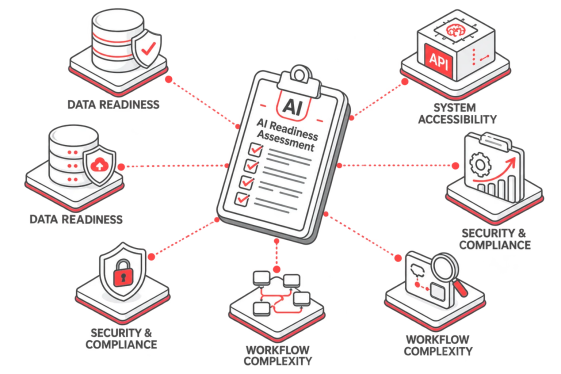
Before recommending an integration architecture, Redblox evaluates:
Data readiness - Is your business data structured, accessible, and clean enough for AI to reason over reliably?
System accessibility - Do your core systems expose APIs, or will middleware be required to bridge them?
Security and compliance posture - What regulatory frameworks (HIPAA, SOC 2, GDPR, PCI-DSS) govern your data?
Workflow complexity - Which processes offer the highest-impact, lowest-risk starting point for AI integration?
Organizational readiness - Are teams prepared to adopt AI-embedded workflows, and what change management is needed?
This assessment forms the foundation of the architecture design phase and ensures every integration is built on a realistic understanding of your environment, not assumptions.
Integration Security
Authentication & access control
Using OAuth 2.0, role-based access, and least-privilege principles for every API connection.
Data encryption
In transit and at rest across all integration points.
Audit logging
Of AI interactions with sensitive systems for compliance and traceability.
Compliance alignment
With HIPAA, SOC 2, GDPR, and PCI-DSS depending on your industry.
Data minimization
AI models receive only the context required for a given task, not unrestricted system access.
Human-in-the-loop controls
For high-risk actions, so AI agents operate within defined approval boundaries.
Private and hybrid deployment
Options for organizations that cannot send sensitive data to public AI APIs.
Deployment Models
Cloud AI Integration
Fastest path to production, using managed AI APIs (OpenAI, Azure OpenAI, Amazon Bedrock, Google Vertex AI) integrated with cloud-hosted business systems.
Private AI Deployment
Models deployed within your own private cloud or on-premises infrastructure, for organizations with strict data residency requirements.
Hybrid AI Integration
A combination approach: sensitive workloads handled by private, on-premises models, while lower-risk tasks use public cloud AI APIs.
The right model depends on your data sensitivity, regulatory environment, budget, and existing infrastructure, something we determine during the AI readiness assessment, not before it.
Support & Maintenance
24/7 monitoring of AI system performance, uptime, and cost
Model performance tracking to catch drift, degraded accuracy, or increased hallucination rates
Prompt and retrieval optimization as usage patterns and business needs evolve
Security patching and compliance updates as regulations and best practices change
Scaling support as adoption grows from a single team to the full organization
Model upgrade management as AI providers release new versions, without breaking existing workflows
Frequently Asked Questions
Trusted by Businesses Worldwide
The metrics behind the methodology. Redblox Technologies has been delivering enterprise software and AI solutions for over a decade, across industries and continents.
0+
Years of Delivery
0+
Projects Delivered
0+
Countries Served
0+
Engineers


Ready to Integrate AI into Your Business?
Integration is the gap between having AI and realizing its benefits. Redblox closes that gap by connecting the AI models you pick to the technologies your company already uses, while providing the security, scale, and dependability required for corporate operations.
Fill your details below and get in touch with our domain experts