AI Governance & Compliance

AI Governance & Compliance Services
for Responsible Enterprise AI

Build, deploy, and scale AI with governance, risk controls, security, and compliance embedded across the AI lifecycle, not bolted on after the fact.

Most businesses did not anticipate how quickly AI would expand throughout the business. A generative AI pilot in marketing becomes a copilot in customer service, transforming into an autonomous agent processing claims or approving transactions, often before the governance, security, or compliance departments are formally involved.

The end result is well-known to most CIOs, CISOs, and Chief Risk Officers: shadow AI usage across business units, multiple foundation models and third-party AI vendors in play at the same time, sensitive enterprise data flowing into tools that no one centrally tracks, and automated decisions made without clear ownership. Regulatory demands are rising at the same time, ranging from the EU AI Act to sector-specific privacy and data protection standards, while corporate AI policies, where they exist, are frequently inconsistent across departments and distant from how AI systems actually operate in production.

When you ask a typical organization how many AI systems are live today, who owns the risk for each one, and how a regulator or auditor may evaluate proof of controls, you will rarely get confident responses. Not because leaders don't care about governance, but because governance was supposed to be a document that sits alongside the technological stack rather than within it.

The problem for organizations today is more than just regulating individual AI models. It is governing AI as an operational capability that spans strategy, data, models, agents, applications, and human oversight, and evolves as those components do.
What Is AI Governance & Compliance?

AI governance, AI compliance, and responsible AI are related but distinct disciplines. Enterprises that treat them as interchangeable tend to end up with policy documents that don't map to real controls. Here is how Redblox defines each.

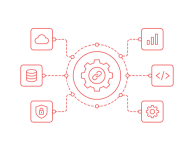
A governance engine at the centre of cloud, data, security, reporting, code, and configuration controls

AI Governance

How an organization establishes accountability, policies, controls, and decision-making around AI. It defines who owns AI risk, how AI systems are approved and monitored, what controls apply at each stage of the AI lifecycle, and how exceptions and incidents are handled.

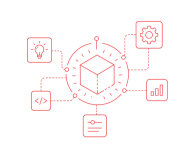
A core AI system surrounded by the evidence it produces: settings, reporting, code, controls, and documented requirements

AI Compliance

How an organization demonstrates that its AI systems and processes meet applicable legal, regulatory, contractual, security, and privacy requirements. Compliance is evidence-driven: it depends on the ability to show, not just assert, that controls exist and operate as intended.

An AI core connected to human review, checklists, conversation, reporting, code, and delivery

Responsible AI

How AI is designed and operated with appropriate consideration for fairness, transparency, safety, privacy, accountability, and human oversight. It shapes the principles that governance and compliance programs are built to enforce.

Our AI Governance & Compliance Services

Redblox's AI governance consulting services cover everything a company needs to responsibly govern AI, from strategy and policy to model, data, agent, and security controls, as well as continuous audit preparedness.

AI Governance Strategy & Framework Design

We help define the governance operating model for enterprise AI: governance principles, governance committees, roles and responsibilities, approval workflows, AI lifecycle controls, risk ownership, and a governance maturity roadmap suited to where the organization is today.

AI Risk Assessment & Management

We create and manage an AI use-case inventory, categorize risk based on impact and likelihood, and evaluate model, data, security, privacy, operational, third-party, and agentic AI risks. Each use case receives a risk assessment and a mitigation plan, ensuring that risk decisions are consistent throughout the firm.

AI Policy Development & Management

We help develop and manage enterprise AI policies, including generative AI acceptable-use policies, AI procurement policies, model usage policies, data handling policies, human oversight policies, and AI incident policies, along with the mechanisms needed to enforce them in practice, not just publish them.

Generative AI Governance

We help govern how generative AI is actually used: LLM usage policies, prompt governance, sensitive data protection, model and provider assessment, output monitoring, hallucination controls, human review checkpoints, content risk management, data leakage prevention, and governance of third-party model providers.

AI Governance Across the AI Lifecycle

Governance works best when it is built into every stage of how AI systems are created and run, not applied once, after deployment.

Step
1

Discover

Identify AI use cases, systems, models, and owners across the organization, including AI that was adopted outside formal IT channels.

Step
2

Assess

Classify risk, identify applicable regulatory obligations, and determine the controls each use case requires before it moves forward.

Step
3

Design

Build privacy, security, human oversight, and compliance requirements into the architecture itself, rather than layering them on afterward.

Step
4

Build

Apply development controls, testing standards, documentation requirements, and evaluation criteria as the system is built.

Step
5

Validate

Evaluate performance, safety, security, fairness, and reliability against defined thresholds before deployment is approved.

Step
6

Deploy

Apply approval gates, access controls, monitoring hooks, and auditability requirements as part of the release itself.

Step
7

Monitor

Track model behavior, drift, data usage, policy exceptions, and incidents on an ongoing basis, not just at launch.

Step
8

Govern

Maintain clear ownership, escalation paths, and decision rights for every AI system in production.

Step
9

Improve

Continuously update controls as models, regulations, data, and business requirements change.

Governance for Modern Enterprise AI

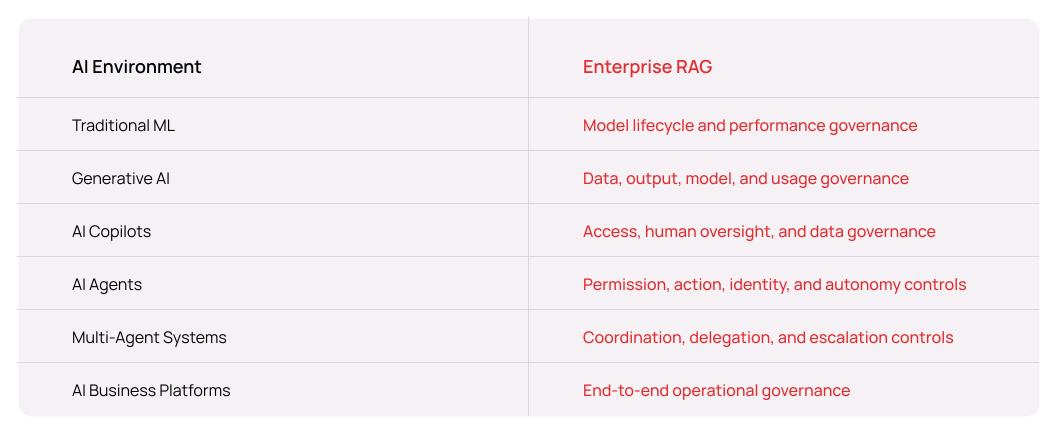
Most enterprises are no longer running one type of AI. Governance has to account for the differences between them.

Table of governance focus by AI environment: traditional ML needs model lifecycle and performance governance, generative AI needs data, output, model, and usage governance, AI copilots need access, human oversight, and data governance, AI agents need permission, action, identity, and autonomy controls, multi-agent systems need coordination, delegation, and escalation controls, and AI business platforms need end-to-end operational governance

Our AI Governance Approach

  1. AI Inventory & Baseline

    A catalog of every AI system, model, vendor, and data flow in use, with an owner named for each and a baseline of current governance maturity.

  2. Risk & Gap Report

    Each use case risk-rated, mapped to its regulatory obligations, and set against the controls it lacks, with remediation prioritized by impact.

  3. Governance Blueprint

    The target operating model: policies, committees, approval workflows, decision rights, and the control set each risk tier requires.

  4. Implemented Controls

    Policies enforced in identity, data, and AI platforms, with approval gates and logging wired into the systems teams already use.

  5. Evidence & Dashboards

    A maintained evidence repository and compliance dashboards that show control status to risk teams, auditors, and the board.

  6. Periodic Governance Review

    A recurring review that updates the inventory, risk ratings, and controls as new use cases, models, and regulations arrive.

Governance Becomes Operational When It Runs Inside the Platform

A governance framework that exists in a shared drive, apart from the systems that run enterprise AI, is difficult to enforce and even more difficult to demonstrate. Redblox connects AI governance to its enterprise AI platform features, including the orchestration layer, data connections, agents, and processes that enable AI across the organization.

This means that policies can be implemented at the moment of action rather than simply documented. Identity and access controls apply to AI agents in the same manner they do to employees. Human approvals are introduced into procedures when a choice truly requires them. Monitoring and audit trails are generated by the systems that perform the work, not rebuilt after. When a new AI use case is discovered, it can be integrated into the existing regulated environment rather than operating outside of it.

This is the difference between AI governance as a compliance exercise and AI governance as an operating capability: the former generates a document, whereas the latter generates a system that organizations can manage, monitor, and defend.

Governance

  • Policies & Rules

AI Platform

  • Controls Embedded

AI Action

  • Policy + Approval

Monitor & Audit

  • Logs + Evidence

Why Choose Redblox Technologies?

Governance Meets Engineering

We don't stop at recommending policies. We help translate governance requirements into technical architecture, workflows, controls, and integrations that actually run in production.

Built for Enterprise AI

Our approach is designed around complex, multi-system enterprise environments, not isolated AI pilots or single-model experiments.

Governance Across the Full AI Lifecycle

From strategy and risk assessment through design, deployment, and continuous monitoring, governance is treated as a continuous thread rather than a one-time review.

Ready for Agentic AI

Our governance models are built for AI agents, automated actions, and multi-agent workflows, where traditional, model-only governance approaches fall short.

Integration-First

Governance is designed to work with the identity systems, data platforms, and AI infrastructure an enterprise already has, rather than requiring a parallel set of tools.

Risk-Based, Not Bureaucratic

Controls are scaled to actual business and AI risk, so governance protects the organization without slowing down every low-risk use case.

Regulation-Aware

Controls are mapped to evolving frameworks such as the EU AI Act and ISO/IEC 42001, so a regulatory update means adjusting a mapping, not rebuilding the program.

AI Governance Across Industries

Financial Services

Model risk governance for credit and underwriting AI; controls for AI-assisted fraud detection; audit trails for automated financial decisioning.

Financial Services illustration

Healthcare & Life Sciences

Governance for AI used in clinical decision support; data governance for protected health information; oversight controls for AI-assisted diagnostics workflows.

Healthcare & Life Sciences illustration

Insurance

Risk classification for AI-driven claims processing; human oversight controls for automated underwriting; audit readiness for AI-influenced coverage decisions.

Insurance illustration

Retail & eCommerce

Governance for personalization and recommendation models; oversight of AI agents handling customer interactions; data governance across customer and transaction data.

Retail & eCommerce illustration

Manufacturing

Governance for predictive maintenance and quality-control AI; oversight of AI-driven supply chain decisions; monitoring for AI systems connected to operational technology.

Manufacturing illustration

Hospitality

Oversight for AI-driven pricing and revenue management; governance of AI copilots used in guest service; data governance across guest and loyalty data.

Hospitality illustration

Real Estate

Governance for AI-assisted valuation and underwriting models; oversight of AI agents used in transaction workflows; audit trails for automated decisioning.

Real Estate illustration

Logistics & Supply Chain

Governance for AI-driven routing and demand forecasting; oversight controls for autonomous planning agents; monitoring for AI systems spanning multiple vendor platforms.

Logistics & Supply Chain illustration

Travel

Governance for AI-driven pricing, booking, and personalization systems; oversight of AI agents handling customer-facing transactions; data governance across traveler information.

Travel illustration

Professional Services

Governance for AI-assisted research and drafting tools; policy management for generative AI used with client data; audit readiness for AI-influenced deliverables.

Professional Services illustration

What Enterprises Gain From
Operational AI Governance

Greater visibility into where and how AI is used across the organization

Reduced AI risk exposure through consistent, risk-based controls

Faster governance decisions with clear ownership and defined approval paths

Improved audit readiness through maintained evidence and documentation

Clear accountability for every AI system, model, and agent in production

More controlled, less ad hoc AI adoption across business units

Stronger protection for sensitive and regulated data used in AI systems

Consistent lifecycle controls from design through retirement

Reduced compliance-related friction when deploying new AI use cases

Greater confidence among boards, regulators, and enterprise stakeholders

Safer scaling of AI automation and AI agents

A governance model that scales as AI adoption grows, rather than breaking under it

Signs Your Organization Needs an AI Governance Program

  • Multiple teams are independently adopting AI tools without coordination.
  • Employees are using generative AI tools with no centralized policy.
  • The organization is deploying AI agents or autonomous workflows.
  • Sensitive enterprise or customer data is being processed by AI systems.
  • There is no centralized inventory of AI systems in use.
  • No one clearly owns AI risk across the organization.
  • AI models are deployed without a standardized approval process.
  • Compliance and risk teams cannot easily determine where AI is being used.
  • AI-related incidents are difficult to investigate or trace.
  • The organization needs to prepare for regulatory scrutiny or an upcoming audit.

If more than a few of these apply, governance is likely already behind AI adoption, which is the point at which risk accumulates fastest.

Frequently Asked Questions

Trusted by Businesses Worldwide

The metrics behind the methodology. Redblox Technologies has been delivering enterprise software and AI solutions for over a decade, across industries and continents.

0+
Years of Delivery
0+
Projects Delivered
0+
Countries Served
0+
Engineers
HIPAA CompliantISO 27001:2022 CertifiedISO 14001:2015 CertifiedISO 9001:2015 CertifiedGDPR CompliantSOC Analyst (ITCERTS)ESC Member

Govern AI With Confidence. Scale It With Control.

AI usage is accelerating throughout the workplace. Governance cannot be a post-deployment document; it must be built into how AI is conceived, administered, and monitored from the beginning. Redblox assists organizations in establishing an AI governance foundation that promotes responsible innovation, regulatory preparation, operational control, and long-term growth.

Fill your details below and get in touch with our domain experts

Name*
Email*
Phone*
Company*
Requirements*