

Multiple disconnected AI tools
Every department picks its own AI vendor for its own narrow problem. None of these tools were built to talk to each other, so the organization ends up with more software to manage, not less complexity.
AI Agent Orchestration Services
Redblox Technologies designs, builds, and operates AI Agent Orchestration Services that connect your AI agents, enterprise applications, and business workflows into a single coordinated system, so decisions get made faster, work moves without human handoffs, and your enterprise finally runs like one connected organism instead of a hundred disconnected tools.
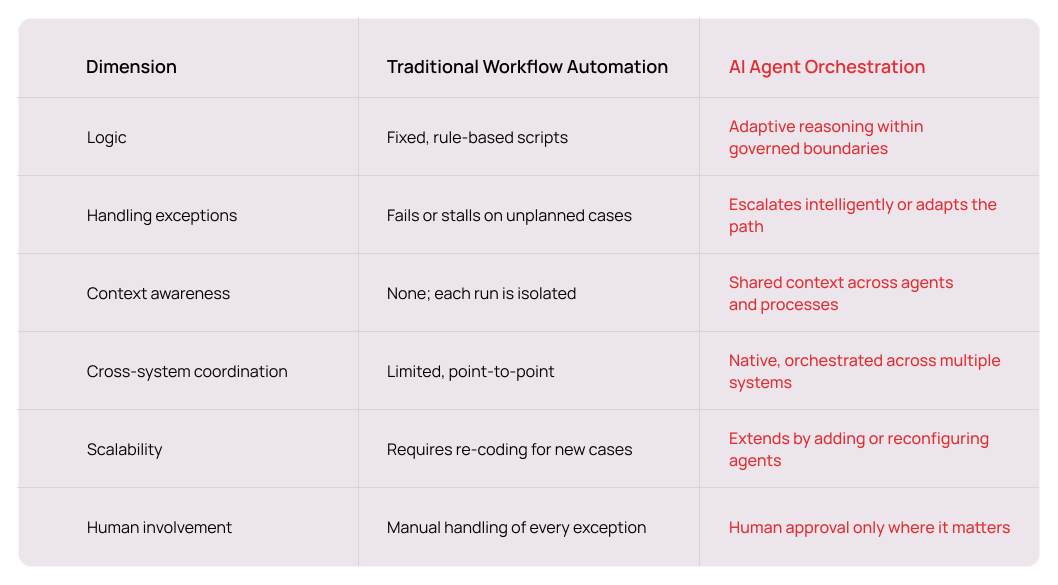
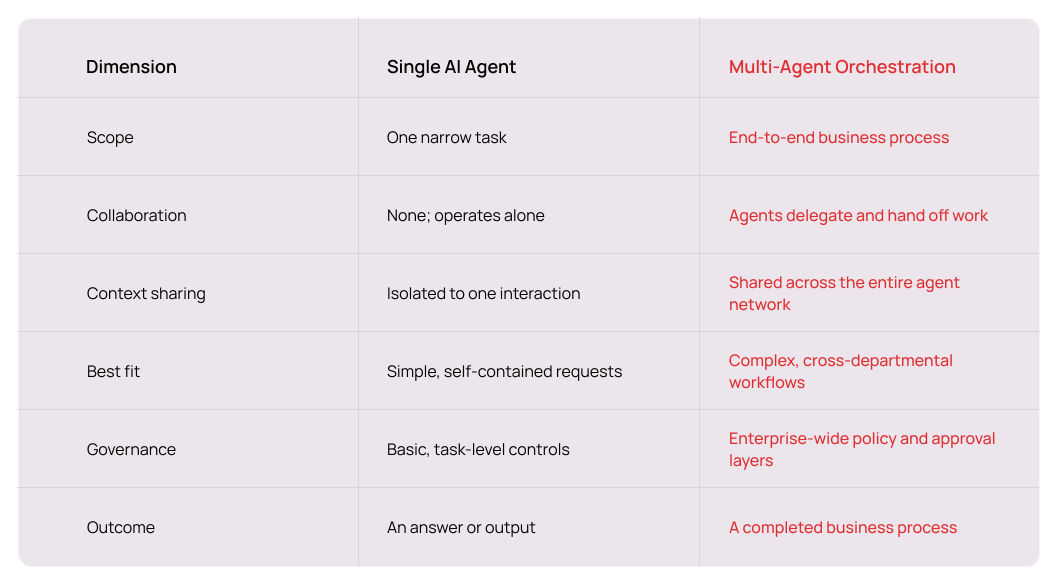
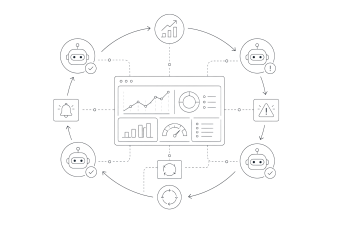
Think of a single AI agent as a specialist employee. It's good at one job: answering a question, drafting a document, extracting data from an invoice. An AI Agent Orchestration Platform, by contrast, behaves like a well-run operations team. A planner agent breaks a business request into steps. A coordinator agent assigns those steps to the right specialist agents. Specialist agents pull data from your systems, apply business logic, and hand results back for review. A human approves what needs approving. The outcome isn't a single answer, it's a completed business process.
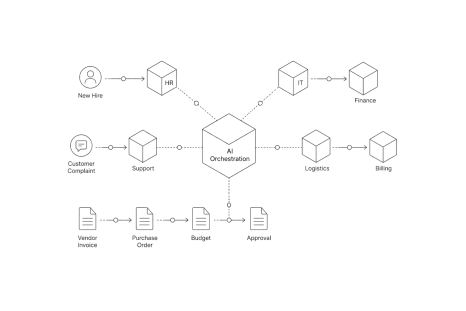
Enterprises don't run on single tasks. They run on multi-step processes that cross departments, a new hire needs onboarding across HR, IT, and finance; a customer complaint needs input from support, logistics, and billing; a vendor invoice needs validation against a purchase order, a budget, and an approval chain. A standalone AI agent can help with one piece. Only orchestration can carry the whole process through.
Every department picks its own AI vendor for its own narrow problem. None of these tools were built to talk to each other, so the organization ends up with more software to manage, not less complexity.
An AI agent in sales has no visibility into what the AI agent in finance already knows about the same customer. Context that should flow freely between systems instead has to be re-entered, re-explained, or re-discovered every time.
Someone still has to read the chatbot's output, copy it into the ERP, check it against a spreadsheet, and email a colleague for sign-off. The AI removed one manual step and left three others in place.
Without a shared memory layer, agents forget prior interactions, repeat questions customers or employees already answered, and produce inconsistent recommendations across departments.
Work still queues up at the same points it always did, waiting for a human to notice, review, and route it, because the AI tools were never connected to the workflow engine that actually moves work forward.
Ironically, many “AI-powered” processes still require more human oversight than the manual process they replaced, because someone has to babysit every handoff between tools.
A pilot that works beautifully in one team rarely survives contact with a second department's systems, data formats, and approval chains, because it was never designed as part of a broader Enterprise AI Solution.
Whatever shape your operation takes, orchestration is the layer that ties your AI agents, applications, and people into one coordinated system. These are the services we build to get you there.
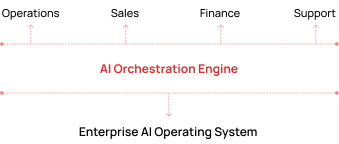
The foundation layer, we design and deploy the orchestration architecture that lets your AI agents operate as one coordinated system, aligned to how your business actually makes decisions.
Central orchestration layer, agent role design, task routing logic, cross-department context sharing, governance controls baked in from day one.
A single source of coordination instead of dozens of disconnected tools; faster process completion; a platform that scales as new use cases are added.
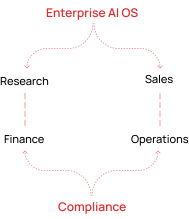
We build networks of specialist agents, each trained and scoped for a specific function, that plan, delegate, and hand off work to one another with minimal human intervention.
Role-based agent design, delegation protocols, inter-agent messaging, shared task memory, conflict-resolution logic when agents disagree.
Complex, multi-step work gets completed end-to-end rather than stalling at the first handoff; specialist agents stay focused and accurate rather than trying to do everything.
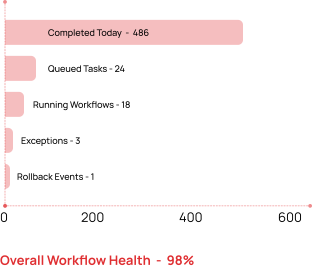
Connecting AI decision-making directly into your operational workflows, so agents don't just recommend; they execute, within the boundaries you set.
Workflow engine integration, conditional routing, exception handling, real-time status tracking, rollback and audit trails.
Fewer manual handoffs, faster turnaround on routine processes, full visibility into where every task stands.
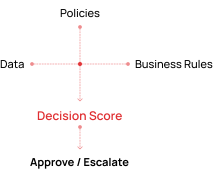
For decisions that involve multiple data sources and business rules, we build orchestration logic that gathers the right inputs, applies the right rules, and presents (or executes) the right decision.
Decision-engine integration, rules and policy layers, confidence scoring, escalation thresholds for human review.
Consistent decisions at scale, faster response times, reduced reliance on manual judgment for routine cases.
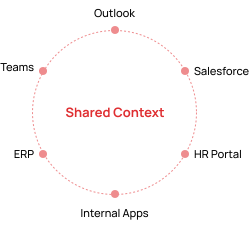
Many enterprises already have copilots embedded in Microsoft 365, Salesforce, or internal tools. We orchestrate these copilots so they act on a shared context instead of operating as isolated assistants.
Copilot-to-agent bridging, unified context store, cross-application task handoff, consistent governance across all copilot touchpoints.
Employees get one coherent AI experience across tools instead of several inconsistent ones; existing copilot investments get more value rather than being replaced.
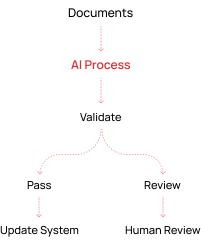
Beyond simple task automation, we combine AI reasoning with process execution so routine, rules-heavy work is completed without manual intervention while remaining fully auditable.
Document and data extraction, validation logic, system-of-record updates, exception queues for human review.
Lower processing costs, faster cycle times, fewer errors from manual data entry.
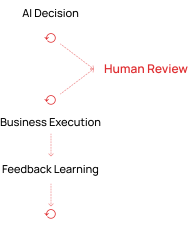
Autonomy without oversight is a liability in the enterprise. We design approval checkpoints, escalation paths, and review interfaces so people stay in control of decisions that matter.
Configurable approval thresholds, role-based review queues, full decision audit trails, override and feedback loops that improve agent performance over time.
Confidence to deploy AI in sensitive processes; compliance-ready decision trails; better agent outcomes as human feedback is incorporated.
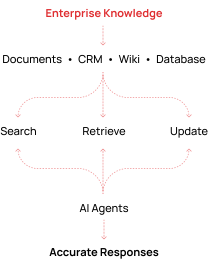
We connect your organization's scattered knowledge, documents, wikis, CRM notes, support tickets, internal databases, into a shared context layer that every agent can draw on.
Enterprise knowledge retrieval, vector-based semantic search, access-controlled knowledge sharing, continuously updated context as new information is created.
Agents give accurate, current answers instead of outdated or generic ones; institutional knowledge becomes usable rather than buried in silos.
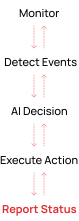
For mature use cases, we design orchestration systems that manage entire operational loops with limited human intervention, monitoring, deciding, acting, and reporting continuously.
Continuous monitoring agents, automated exception detection, self-adjusting workflows, executive-level reporting dashboards.
Round-the-clock operational coverage; faster response to operational anomalies; leadership gets visibility without manual reporting effort.
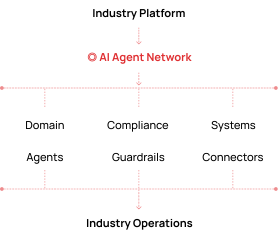
Generic AI doesn't understand the nuance of your industry's processes, compliance requirements, or terminology. We build agent networks tuned to the specific operational reality of your sector.
Industry-specific agent training and vocabulary, compliance-aware guardrails, pre-built connectors for common industry systems.
Faster time to value because agents already understand the domain; fewer errors from generic, one-size-fits-all AI models.
AI Agent Orchestration follows a lifecycle that mirrors how a well-run team would handle any complex request, only faster, and available continuously.
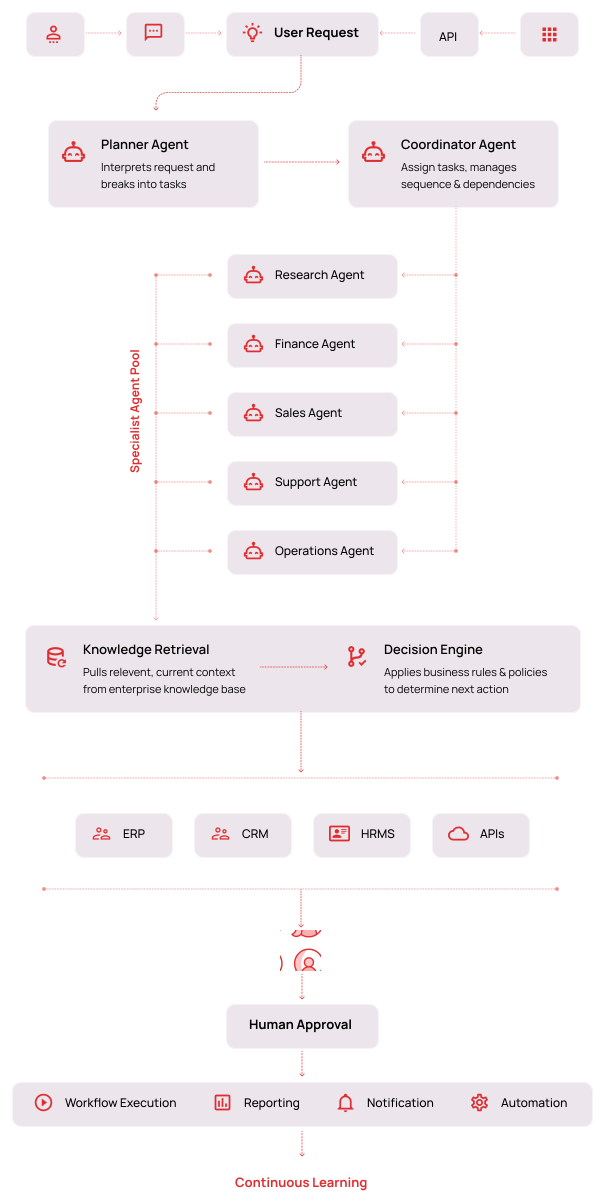
A request enters the system, from an employee, customer, or another business application.
This agent interprets the request and breaks it into the discrete steps required to fulfill it.
The coordinator assigns each step to the right specialist agent and manages sequencing and dependencies.
Purpose-built agents execute their assigned piece of work, retrieving data, drafting content, validating information, or performing calculations.
Agents pull relevant, current context from your enterprise knowledge base rather than relying on generic or outdated information.
Business rules and policies are applied to determine the recommended or automated next action.
The system writes results directly into your ERP, CRM, HRMS, or other systems of record.
Where a decision requires sign-off, the right person is notified with full context, ready to approve, adjust, or reject.
Once approved, the workflow completes, and downstream systems and stakeholders are updated automatically.
Outcomes and human feedback feed back into the system, improving accuracy and efficiency over time.
AI Agent Orchestration only creates value when it connects to the systems where enterprise work actually lives. Redblox builds orchestration layers that integrate cleanly with:
so agents can validate orders, check inventory, and update financial records without manual re-entry.
so customer context, deal history, and communication logs are available to every relevant agent in real time.
so employee lifecycle processes, from onboarding to leave approvals, can be orchestrated end-to-end.
so approvals, reconciliations, and reporting draw on live financial data rather than exports and spreadsheets.
so agents can work directly within the documents, email, and calendars employees already use daily.
so agents can notify, request approvals, and share updates inside the collaboration tools teams live in.
so orchestration extends into core operational and financial processes at the system-of-record level.
so sales and marketing agents act on the same customer data your revenue teams already trust.
so IT and service-desk workflows can be coordinated by agents alongside human teams.
so custom or legacy systems are brought into the orchestration layer rather than left outside it.
Redblox Technologies selects each component of the stack for a specific engineering reason, not because it's trending.
We build on large language models including OpenAI, Anthropic Claude, Google Gemini, and open-weight models like Llama, choosing the right model per workload based on reasoning quality, cost, latency, and data residency requirements ; a single-vendor approach rarely fits every enterprise use case.
For orchestration, we rely on frameworks such as LangChain, LlamaIndex, LangGraph to manage retrieval pipelines, agent workflows, and multi-step reasoning, and we implement MCP so AI systems can securely connect to enterprise tools and data sources through a standardized interface rather than brittle custom integrations.
On the retrieval layer, we work with vector databases including Pinecone, Weaviate, Milvus, and ChromaDB, selected based on scale, hybrid-search needs, and deployment model (managed cloud versus self-hosted). We pair these with Elasticsearch for keyword and hybrid search, PostgreSQL for structured and relational data, and Redis for low-latency caching of frequent queries.
The application layer is typically built in Python with FastAPI, chosen for its speed and strong ecosystem of AI tooling. We containerize services with Docker and orchestrate them with Kubernetes, giving enterprise deployments the resilience and scalability to handle production traffic. Cloud deployment is flexible across AWS, Azure, and Google Cloud, matched to each client's existing infrastructure and compliance obligations.
AI Agent Orchestration adapts to the operational realities of each sector, coordinating the workflows, systems, and compliance requirements specific to your industry.
AI agents coordinate reservations, guest requests, housekeeping schedules, and concierge services, resolving routine guest needs automatically while escalating complex requests to staff with full context attached.

Orchestrated agents manage lead qualification, property matching, document collection, and coordination between agents, buyers, and back-office teams, shortening the time from inquiry to closing.

Agents coordinate appointment scheduling, insurance verification, and administrative documentation, freeing clinical staff from repetitive coordination work while keeping compliance and human oversight central to every workflow.

Orchestration connects production planning, inventory, and maintenance agents so supply issues, quality flags, and scheduling conflicts are detected and routed before they become downtime.

Agents coordinate inventory visibility, customer service, and order management across channels, so a customer question, a stock issue, and a fulfillment update are all handled by a system working from the same data.

Orchestrated agents track shipments, flag delays, coordinate with carriers, and update customers automatically, reducing the manual monitoring that traditionally falls on operations teams.
Agents orchestrate reconciliation, fraud-flag review, and reporting workflows, applying consistent policy logic while keeping every material decision inside a human-approval workflow.

Agents coordinate admissions processing, student support requests, and administrative workflows, giving staff more time for direct student engagement while routine coordination runs in the background.

Every service described on this page is powered by OtonomiQ, Redblox Technologies' proprietary AI orchestration platform. OtonomiQ is not a chatbot, and it is not a replacement for your ERP, CRM, or core business systems , it is the intelligence and orchestration layer that sits above them, connecting AI agents, enterprise applications, workflows, and business intelligence into one unified operating layer.
OtonomiQ also embeds governance and operational intelligence directly into the orchestration layer. Every agent operates within permissions and policies your organization defines. Every decision that requires human judgment is routed to the right person, with full context and a complete audit trail. Every action agents take is visible in real time, so leadership always has a clear view of what the system is doing and why.
For enterprises evaluating an AI Agent Orchestration Platform, OtonomiQ represents Redblox's own answer to the question this entire page has been building toward: what does it take to make AI agents actually work together, inside a real enterprise, under real governance? OtonomiQ is that answer, engineered and continuously refined by the same team that designs and delivers every orchestration engagement Redblox undertakes.
Coordinates every AI agent
ERP • CRM • APIs • HRMS
Monitoring • Analytics
Improves every workflow
Permissions you define
Decisions routed with context
Full audit trail, live
One unified operating layer
From understanding your operations to continuous optimization after go-live, every engagement follows a structured, enterprise-ready path.
We start by understanding your operational bottlenecks, existing systems, and the business outcomes that matter most, not by pitching technology first.
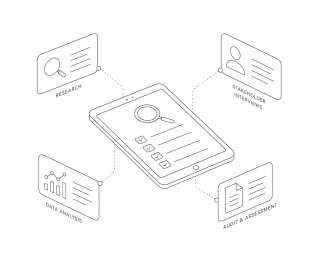
We evaluate your data quality, system landscape, and organizational readiness for agent-driven workflows.
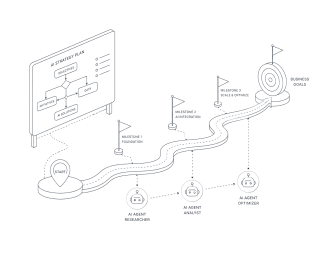
We design the specific agents your business needs, their roles, and how they should interact.
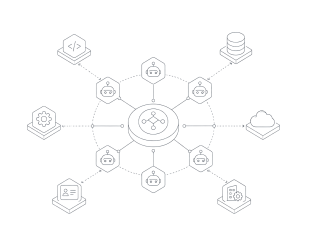
We define how agents, workflows, and governance rules fit together into a coherent operating model.
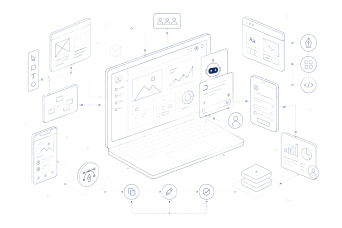
We connect the orchestration layer to your ERP, CRM, HRMS, and other systems of record.
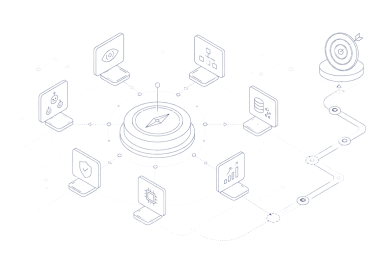
We select and deploy the right models for each agent based on task requirements, cost, and performance.
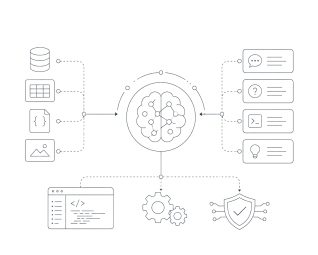
We implement permissions, approval workflows, and compliance controls before any agent touches live data.
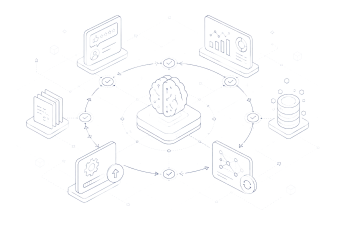
We validate agent behavior, edge cases, and failure handling in a controlled environment before go-live.
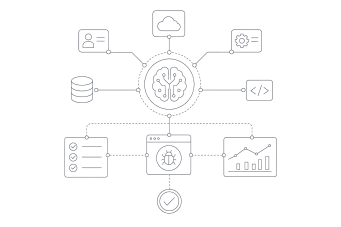
We roll out the orchestration system in stages, starting with high-value, well-understood processes.
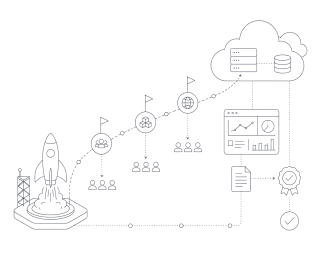
We monitor performance, gather feedback, and refine agent behavior and workflows as your business evolves.
Redblox measures success in business outcomes , cycle time reduced, manual effort eliminated, decisions made faster , not in the number of models deployed.
Straightforward answers to the questions technology and operations leaders ask most often when evaluating AI Agent Orchestration.
The metrics behind the methodology. Redblox Technologies has been delivering enterprise software and AI solutions for over a decade, across industries and continents.



Every enterprise eventually reaches the same realization: adding more AI tools isn't the same as becoming an AI-driven organization. The difference is orchestration , the layer that turns isolated intelligence into coordinated action across your entire business.
Schedule a discovery session with Redblox Technologies and see what a fully orchestrated, intelligent business system could look like inside your organization , not someday, but as your next deployment.


